A Portland crash may need recovery before the vehicle can be towed. The deciding details are its road position, wheel condition, steering, body damage, and whether it left the pavement.
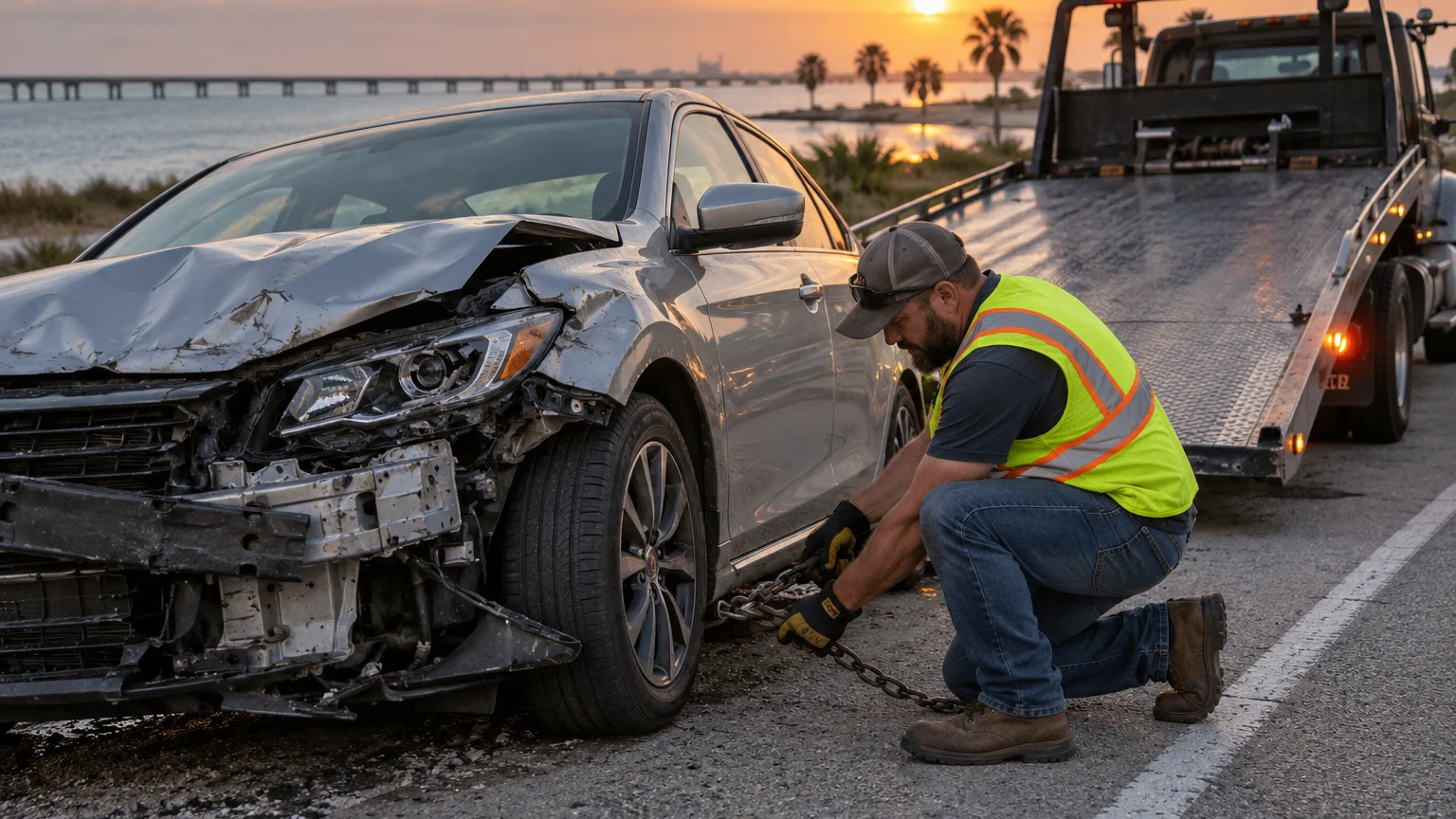
A standard tow usually fits an accessible vehicle that can be loaded normally. Recovery becomes the better match when the operator must first reposition, stabilize, or extract it. Sharing the scene clearly helps us connect you with an independent, licensed operator prepared for the actual job.
Describe the vehicle’s road position
Start with where the vehicle stopped, not where the crash began. Its final position tells an operator more about the loading problem.
Say whether the vehicle is upright and entirely on pavement. Explain if it faces with traffic, across a lane, toward a barrier, or at an angle. Mention whether its front or rear sits closer to the roadway edge. If another damaged vehicle blocks direct access, include that too.
Use fixed landmarks when describing a Portland scene. “Near US 181” covers too much ground by itself. Add the travel direction, nearby exit, cross street, business, or bridge approach. A dropped map pin can help distinguish two similar-looking stretches of road.
Also describe the space around the vehicle. A car in an open parking area presents a different loading setup than one beside a barrier. The same applies when a vehicle rests close to another car, sign, curb, or roadside structure.
Don’t label the job “just a tow” before explaining its position. A vehicle may look mostly intact while sitting at an angle that prevents routine loading. The reverse can also happen. Visible body damage doesn’t always mean an extraction is needed if the vehicle remains accessible.
Our accident recovery and winch-out service covers calls needing more than ordinary loading. For a broader explanation, compare accident recovery with a standard tow. Those details help you use the right description when requesting crash towing in Portland, Texas.
Share wheel, steering, and body damage
Next, describe each wheel you can see. Wheel condition often changes how an operator approaches the vehicle.
Report whether a tire is flat, missing, folded under the car, or pressed against damaged bodywork. Say if a wheel points in a different direction from the others. If broken parts touch the pavement, describe their location without guessing what failed.
Steering matters as well. Tell the dispatcher whether the steering wheel turns and whether the front wheels respond. If you don’t know, say that plainly. An honest “not confirmed” is more useful than assuming the car can steer.
Body damage can affect access to normal loading points. Mention crushed panels, a hanging bumper, loose trim, or a wheel opening pressed against a tire. Note whether the hood, trunk, or doors appear out of position. You don’t need to diagnose the damage.
Also report visible fluid beneath the vehicle. Describe the location and appearance without identifying the substance unless it has been confirmed. The operator can use that observation when evaluating the call.
Short videos or clear photos may help explain complicated damage. Capture the whole vehicle, its position, and the affected wheels when those views are already available to you. Avoid sending only a close-up that hides the surrounding space.
The goal isn’t to choose equipment yourself. It’s to give the matched operator enough information to evaluate the loading conditions. Wheel, steering, and body details can separate a routine accident tow near Portland from a recovery job requiring additional positioning.
Explain whether the vehicle left the pavement
A vehicle that left the pavement needs a more precise description. “In a ditch” doesn’t explain the angle, distance, surface, or obstacles involved.
State whether all four wheels remain on a firm surface. If only the front or rear wheels left the pavement, say which end. Describe whether the vehicle is level, leaning, nose-down, or resting against something. Mention mud, loose soil, standing water, brush, or a curb only when you can clearly see it.
Estimate nothing you can’t judge reliably. You don’t need to provide an exact slope or distance. A simple comparison works better, such as “the rear wheels are just beyond the pavement” or “the entire car is below road level.”
Tell the dispatcher if the vehicle crossed a curb, median edge, or drainage area before stopping. Also mention any fence, post, barrier, or debris between the road and the vehicle. These details affect how the operator can reach and reposition it.
Don’t assume a vehicle can drive back onto the pavement because its engine runs. Crash damage may affect the wheels, steering, or clearance. Report what you observe and let the licensed operator evaluate the recovery method.
A clean roadside winch-out and a collision recovery aren’t automatically the same job. Crash damage adds questions about rolling, steering, and loading after extraction. That’s why the full description matters.
If the car never left the pavement but can’t be loaded normally, it may still need recovery work. Road position and mechanical condition matter together. Neither detail should be considered alone.
What changes near US 181 and bridge approaches
Vehicle recovery near US 181 requires an exact location description. The Portland corridor includes through lanes, ramps, intersections, frontage access, and bridge approaches. A vague Portland location can point to very different loading conditions.
Start with your direction of travel. Then identify the closest exit, ramp, intersection, or visible landmark. Make clear whether the vehicle is on US 181 itself, beside it, or on a connecting road. If a map app supplies a pin, share it with the call details.
Bridge approaches deserve extra clarity because “near the bridge” can refer to either side or several connecting points. State whether you’re on the Portland side or traveling toward Corpus Christi. Describe the lane or paved area containing the vehicle without guessing a formal road designation.
Don’t use a landmark as a substitute for the pin. A landmark helps confirm the general area, while the pin shows the operator where the disabled vehicle stopped. Together, they reduce confusion between nearby ramps and road segments.
The crash position still controls the recovery match. A vehicle beside US 181 may need a standard tow if it remains accessible and rolls normally. Another vehicle nearby may need recovery because it left the pavement, lost a wheel, or stopped against a barrier.
For non-crash vehicle trouble along the inland corridor, see our guide to a Highway 181 breakdown from Portland to Sinton. Crash calls need the added damage and position details covered here. Drivers seeking help after a collision can also review our emergency towing referral service.
Confirm the recovery need, destination, and quote
Before dispatch, summarize the call in one clear sequence. Give the exact location, vehicle type, final road position, visible wheel damage, steering condition, and whether it left the pavement.
Then identify the requested destination. That might be a repair facility, body shop, storage location, or another address chosen for the vehicle. Confirm that destination with the independent operator before work begins. If the destination hasn’t been decided, say so during the call.
Ask whether the operator understands the vehicle’s current condition. Repeat any detail that could change the job, especially a detached wheel, blocked access, off-pavement position, or vehicle that won’t roll. Don’t rely on the word “accident” to communicate those conditions.
The operator matched to the call quotes the price before doing the work. Confirm what the quote covers directly with that operator. Quick Tow Corpus Christi is a referral service and doesn’t set the operator’s price. The driver contracts with and pays the independent operator.
Texas requires towing companies operating tow trucks over public roadways to be licensed. Towing operators also hold licenses based on the work they perform. Consumers can check an operator through the TDLR license search using a name, license number, city, county, or ZIP code.
Every operator in our network is licensed and insured. Still, your description must match the scene. If the position or damage changes before dispatch, update the call details. A clear final confirmation helps match the Portland accident recovery request to the job as it actually stands.
When to call us
Call when a crash-damaged vehicle near Portland needs a licensed towing operator, especially when it won’t roll, steer, or load normally. Call us at (361) 967-8088 and we’ll connect you with a licensed operator.