If you’re searching for a semi truck jump starter near me, identify the vehicle as a tractor immediately. Quick Tow connects you with independent operators, but not every roadside provider has suitable equipment for every tractor.
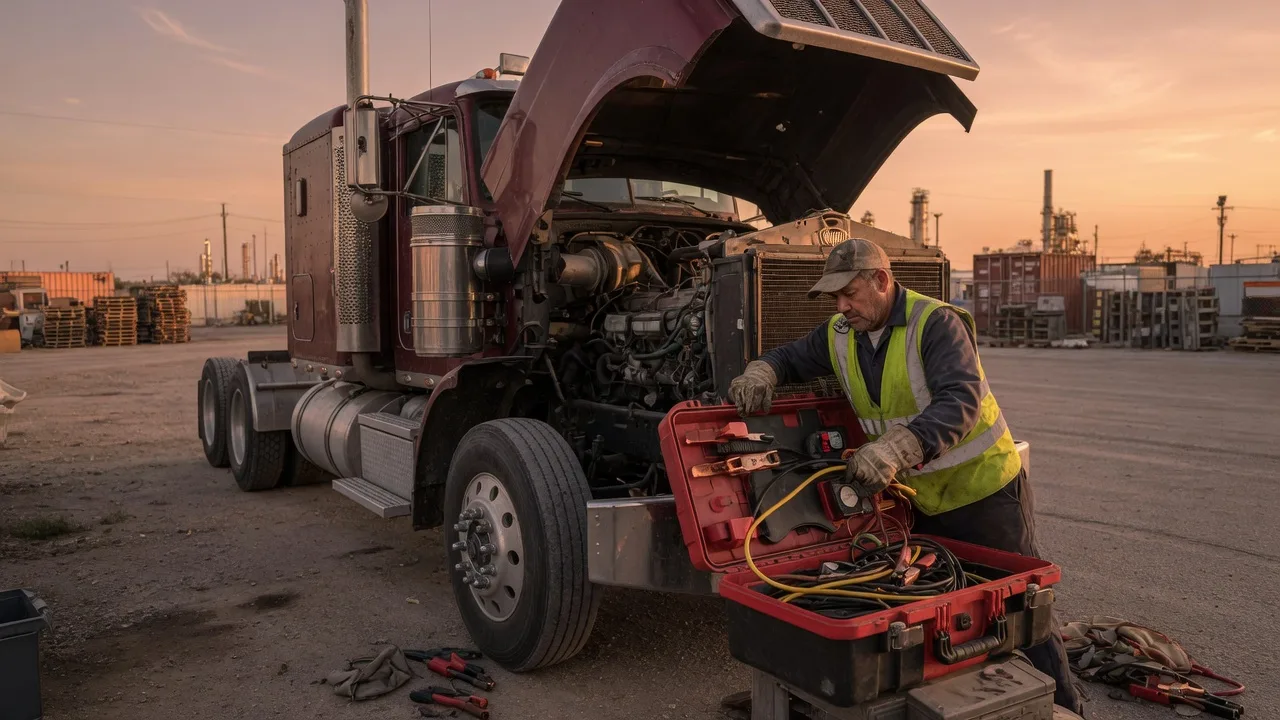
The right details help the matched operator evaluate the request before heading out. Share the tractor, battery, access, parking, and destination information you can confirm.
Tell the operator it is a tractor, not a pickup
Start with the vehicle type. Say that you need a tractor-trailer jump start, not help for a pickup or passenger car. A search for “heavy duty jump start near me” can return providers serving several vehicle classes. Clear wording helps keep your request in the correct category.
Give the tractor’s make, model, and model year. State whether a trailer is attached. If it is, describe the trailer type and whether it’s loaded. Don’t guess at weight, cargo, or mechanical details. Tell the operator what you know and mark everything else as unknown.
Also explain whether you’re driving your own tractor, working for a carrier, or handling the call for another driver. The operator may need to know who can approve roadside work and payment. If dispatch or fleet management controls those decisions, have that contact available.
Describe the immediate symptom in simple terms. Useful descriptions include no sound, clicking, dim lights, or electrical accessories working without the engine starting. Don’t turn those observations into a diagnosis. “The lights come on, but the engine won’t crank” is more helpful than declaring that the starter has failed.
Mention any recent work or warning message you can confirm. If the tractor stopped after running, say so. If it was parked and wouldn’t restart, say that instead. Those are different situations for the operator to assess.
Our roadside assistance referral service connects callers with independent providers. Every operator in the network is licensed and insured, but equipment and job acceptance can vary. The operator must confirm that the tractor jump-start request fits the equipment available for that call.
Share battery, voltage, and whether the truck can roll
Tell the operator what’s printed on the tractor or battery labels. Don’t assume the electrical setup from the truck’s size or appearance. If you can safely read a label without moving parts or removing covers, share the wording exactly.
The operator may ask about battery count, battery location, terminal access, and the voltage shown on a label or dashboard. If you can’t confirm one of those details, say “unknown.” A clear unknown is better than a confident guess that leads to unsuitable equipment.
Explain what still works. Note whether the cab lights, dashboard, liftgate, auxiliary equipment, or other electrical items respond. Report any warning text exactly as displayed. You can take a photo for the operator, but avoid sending a screen that exposes private fleet, customer, or cargo information.
Next, describe whether the tractor can roll. Tell the operator whether the brakes are released, the transmission can be placed as directed, and the steering is accessible. Don’t force any control that isn’t responding. If the tractor can’t move, the operator needs that detail before discussing placement or possible towing.
Access matters too. Battery compartments may be blocked by another vehicle, a wall, a trailer position, or tightly spaced parking. Tell the operator which side is open and how close another service vehicle can get. Include overhead limits, gate restrictions, soft ground, curbs, and loading activity.
A passenger-car battery call needs different information. Our guide to a dead car battery in Corpus Christi covers that situation. This request concerns a tractor, so the matched operator must confirm suitable equipment and access before accepting the job.
I-37, US 77, and port-area parking details
A tractor’s location needs more detail than a dropped map pin. Start with the road, travel direction, nearest exit, and a visible landmark. Then describe exactly where the tractor sits.
On I-37, state your direction of travel and whether you’re on a shoulder, ramp, frontage road, or nearby lot. On US 77, include the nearest confirmed town, exit, intersection, or business. “Near Robstown” or “north of Kingsville” still covers a broad area, so add a pin and a landmark when possible.
Corpus Christi, Portland, and the Northside aren’t interchangeable locations. Neither are Flour Bluff, Padre Island, Robstown, and Kingsville. Say the city or community directly. If your route crossed the Harbor Bridge, don’t assume the operator knows which side you reached before stopping.
Port-area calls need site-specific directions. Give the facility or lot name, gate number, check-in point, and the tractor’s row or parking position. Say whether the operator needs approval from security, a tenant, or site management. Don’t claim access is available until the site confirms it.
If you’re in a private yard, identify the entrance that can accommodate the operator’s service vehicle. A pin placed inside a large property may not lead to the correct gate. Share a second pin for the entrance when needed.
For a roadside position, report the shoulder width only as you see it. Mention barriers, curves, nearby traffic, or limited approach space without declaring the scene safe. Follow directions from law enforcement, road personnel, or the property controlling the site.
If you’re deciding between roadside work and recovery, see our guide to 18-wheeler roadside help or towing. It explains the information needed when a tractor problem may extend beyond a jump.
When a jump is not enough and a tow may be needed
A jump-start request doesn’t guarantee that the tractor will start or remain operable. The operator must evaluate the tractor, its access, and the symptoms present. Don’t ask for a guaranteed result before the equipment is connected and the situation is inspected.
Tell the operator about anything beyond a suspected weak battery. That includes visible cable damage, loose components, unusual smells, leaking fluid, smoke, collision damage, or warning messages. Describe only what you observe. Don’t touch damaged parts or diagnose the cause.
The tractor may also have a separate problem that prevents movement. Share whether it can roll, steer, and be positioned as directed. If a trailer is attached, explain whether it can be separated and who can authorize that step. Loaded trailers, restricted sites, and blocked wheels can change what the operator is willing or equipped to handle.
If the tractor starts, the operator may still tell you that further service is needed. Where the vehicle goes next is a decision for the driver, carrier, mechanic, and operator involved. Have a repair destination or fleet instruction ready, but don’t move the tractor against professional or site directions.
If a jump isn’t suitable, the next conversation may involve heavy-duty towing. Heavy-duty work is quoted separately from Quick Tow’s published light-duty rates. The independent towing operator sets the job price and collects payment directly.
A tow also requires more information than a jump. Expect to discuss the tractor, attached trailer, load status, wheel condition, parking angle, access, and destination. The operator decides whether the available truck and equipment fit the job. Quick Tow makes the referral and doesn’t perform the roadside work or tow.
Confirm equipment, destination, and the quote
Before accepting the match, repeat the request in one short summary. Include the tractor’s make and model, attached trailer status, reported battery information, exact location, parking position, and whether the tractor can roll. This gives the operator a chance to correct any misunderstanding.
Ask the operator to confirm that the planned equipment fits a tractor jump-start request. Don’t assume every heavy-duty provider carries the same setup. Don’t assume the equipment used for a pickup can handle the tractor. The operator accepting the call should make that determination.
Confirm where the tractor should go if a jump doesn’t solve the problem. The destination might be a fleet yard, repair facility, dealership, or another location selected by the driver or carrier. Provide the exact destination rather than a general area. Also confirm that the destination expects the vehicle and can receive its configuration.
Discuss the quote directly with the independent operator. Quick Tow’s published roadside-call rate starts at $75, while heavy-duty work is quoted separately. That starting figure isn’t a guaranteed total for a semi truck jump start. The matched operator quotes the price before doing the work and receives payment directly.
Ask what the quote covers. Share any access, parking, trailer, or destination detail that could affect the job. If the situation changes before the operator begins, report the change. A tractor that was described as accessible may require a different plan if another vehicle blocks it or site access closes.
Keep the operator’s business name and license information with the call record. Texas requires towing operators and towing companies operating over public roadways to hold the applicable licenses, subject to stated exemptions. Consumers can verify tow operator credentials through the Texas Department of Licensing and Regulation license search.
When to call us
Call when a tractor needs a jump-start assessment or the situation may require a licensed towing operator. Call us at (361) 967-8088 and we’ll connect you with a licensed operator.