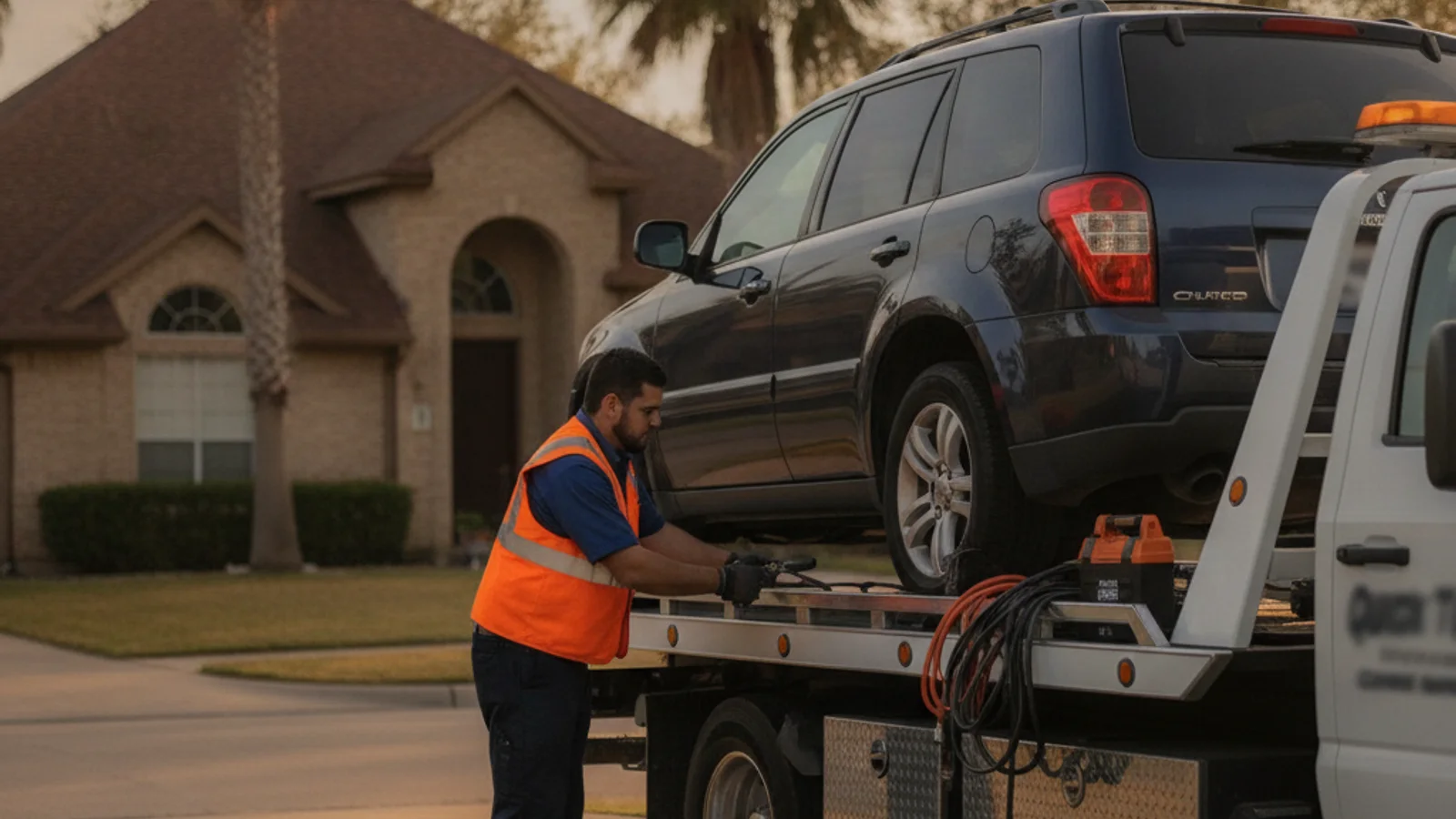
A dead car battery in Corpus Christi almost always shows up the same way: you turn the key, the lights dim, and the engine cranks slow or not at all. If you have jumper cables and a second car, you can usually get moving again in about 10 minutes. If you do not, or the car dies again a few minutes later, call (361) 967-8088 and a jump start goes to a local operator anywhere in the Coastal Bend.
How do you know if you have a dead car battery in Corpus Christi?
Dim lights, slow cranking, or a click can occur with a weak battery, but symptoms alone do not rule out a charging-system, starter, connection, or other fault. Report exactly what the vehicle does and have the cause tested before buying a replacement part.
A weak battery may produce dim interior lights, slow cranking, or a click when you try to start. Those clues are useful to report, but they do not prove the battery is the only problem.
An alternator problem looks different because the car usually starts fine and dies later. If your headlights get dimmer the longer you drive, the dash shows a battery warning light while the engine is running, or the car stalls and won’t restart after you’ve already been driving a while, the alternator is not recharging the battery like it should. A jump might get you moving again, but the same thing happens again in a mile or two.
A click with the lights working can have more than one cause. A jump start may fail to start the vehicle, but that result by itself is not a complete diagnosis. A repair facility can test the battery, connections, charging system, and starter.
If you are not sure which one you are dealing with, that is a normal reason to call. At Quick Tow Corpus Christi, a jump start is a flat-rate roadside call, and if the trouble turns out to be the starter or alternator instead, the driver on scene tells you straight rather than trying a jump that was never going to work.
How do you jump start a car safely?
You jump start a car by connecting jumper cables between a charged battery and a dead one in a specific order, then starting the working car first and letting it charge the dead battery for a few minutes before you try the dead car. Get the order wrong and you risk a spark near the battery or a blown fuse, so follow these steps in sequence.
- Park the donor car close enough that the cables reach, nose to nose or side by side, without the vehicles touching.
- Turn off both engines and set both parking brakes.
- Connect the red (positive) clamp to the positive terminal on the dead battery.
- Connect the other red clamp to the positive terminal on the donor battery.
- Connect the black (negative) clamp to the negative terminal on the donor battery.
- Connect the last black clamp to a bare metal, unpainted surface on the dead car’s engine block or frame, not the dead battery’s negative terminal. This grounds the circuit away from the battery and cuts the risk of a spark near battery gases.
- Start the donor car and let it run for two to three minutes.
- Try to start the dead car. If it turns over, let it idle for a minute before you touch anything else.
- Remove the cables in exactly the reverse order you attached them: ground clamp first, then donor negative, then donor positive, then dead-car positive last.
- Drive the car for 20 to 30 minutes to let the alternator put some charge back into the battery before you shut it off again.
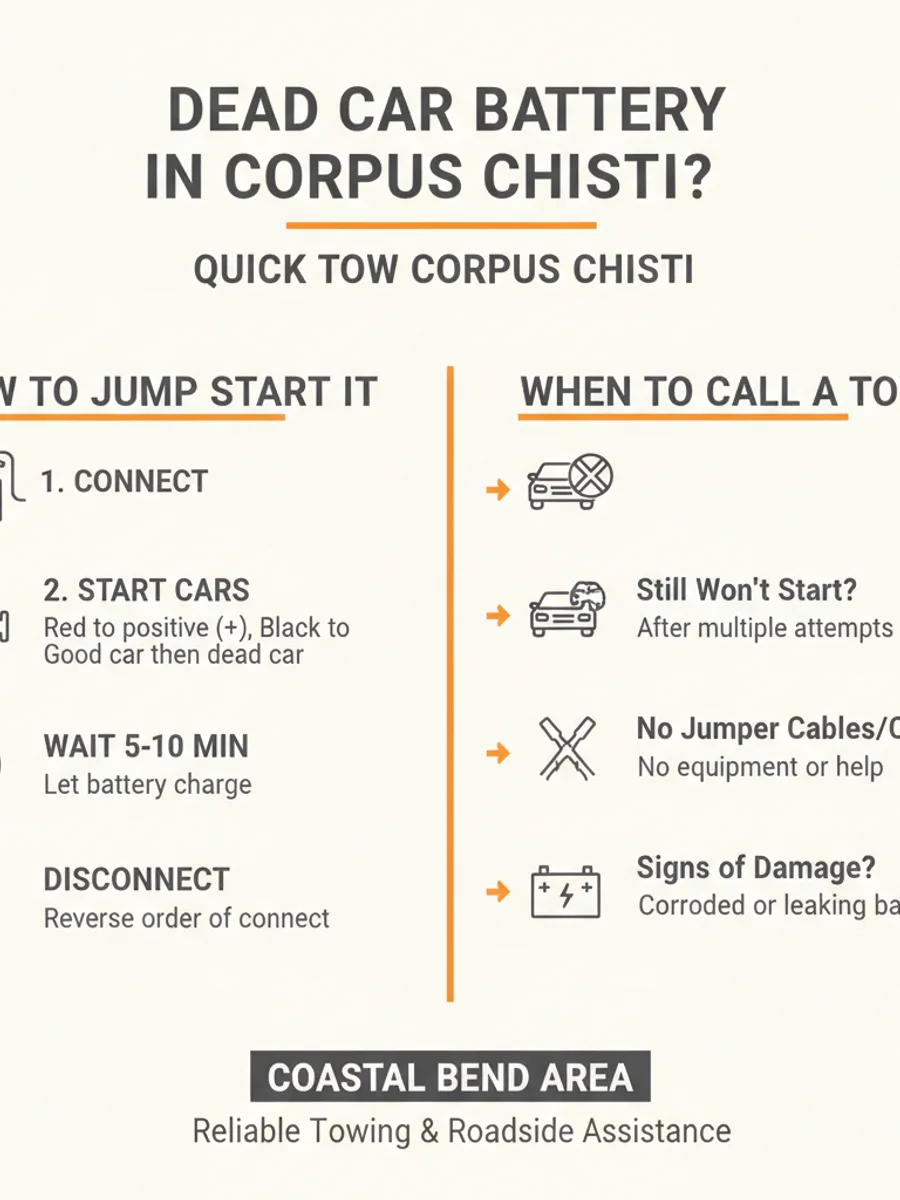
If the car cranks but won’t fire, or it starts and then dies again within a few minutes, stop trying and call for a jump start instead. Repeated crank attempts on a battery that’s already borderline can drain it further or strain a starter that was already struggling.
Why do car batteries die so fast in Corpus Christi?
Heat can shorten battery life, but replacement timing varies by battery, vehicle, use, and condition. Follow the battery maker’s guidance and use a test result rather than a local age rule to decide whether replacement is needed.
Humidity and salt air off the bay add a second layer of trouble. Moisture and corrosion build up on battery terminals and connectors, and a corroded terminal can mimic a dead battery even when the battery itself still has some life left in it. A quick wipe with a wire brush sometimes solves what looks like a full battery failure.
Short trips around town make it worse. A car that only runs a few minutes at a time, quick errands near the bay or a short hop to Flour Bluff, never gives the alternator enough time to fully recharge the battery after starting. Over weeks, that battery sits at a lower charge than it should, and it fails sooner than a battery on a car that gets regular highway miles.
The classic version of this call is a dead battery on a 100-degree afternoon in an H-E-B parking lot on the Southside near La Palmera Mall. The car started fine that morning, sat in direct sun for two hours while you shopped, and now it won’t turn over. That’s heat-stressed battery failure, and it drives a lot of the no-start calls in the Coastal Bend.
What does a new car battery cost?
Battery replacement is not a Quick Tow service and this site does not publish a price for it. Call the parts counter or shop with your year, make, model, and engine before you buy. Larger trucks, batteries with extra cold-cranking amps for towing, and vehicles with stop-start systems or extra electronics cost more than a standard passenger-car battery, so ask for the price on your exact fitment rather than a general figure.
A jump start may get some vehicles running, but it does not identify why the battery lost charge. If the vehicle needs repeated jumps or will not remain running, arrange testing and follow the owner’s manual. A roadside operator can say whether it offers a jump; diagnosis and replacement advice belong to a qualified repair provider.
When should you stop trying and call for help?
Stop trying to jump start the car yourself and call for emergency towing when the battery won’t hold a charge, when you have no donor car nearby, or when you’re stuck somewhere unsafe like the shoulder of SPID or the Harbor Bridge. Trying the same thing over and over in a dangerous spot wastes time you don’t have.
A battery that dies again within a few minutes of a jump, even after you’ve driven around for a while, needs a shop visit, not another jump. That pattern means the battery can’t hold a charge anymore, and jumping it again just delays the same failure.
No donor car is a common problem late at night or in less-traveled parts of the Coastal Bend. Rather than flag down strangers, a call to dispatch gets a truck with its own jump box on board, no second vehicle required.
Location matters as much as the mechanical problem. A dead battery on the shoulder of SPID, on the Harbor Bridge span, or anywhere else with fast-moving traffic and no real shoulder is not a place to pop the hood and start connecting cables. Get to a safe spot if you can, or stay buckled in with hazards on and call for help rather than working under the car in traffic.
A battery that’s corroded, cracked, or leaking anywhere near the terminals is a stop-and-call situation too. Battery acid and corrosion buildup are a chemical hazard, not something to touch with bare hands or force a jump onto.
Hybrid and electric vehicles can have both a high-voltage traction battery and a separate low-voltage system. Procedures vary by model. Do not improvise: use the owner’s manual and confirm that the roadside provider follows the manufacturer’s jump-start instructions for your exact vehicle.
If any of those apply, or you’re just not sure, call (361) 967-8088. The drivers in the Quick Tow network run 24-hour towing across Corpus Christi and the wider Coastal Bend, from a stall near Portland to a dead battery out toward Kingsville.
Frequently asked questions
Can a completely dead battery be jump started?
Usually, yes. A battery with zero charge left will still take a jump in most cases, as long as it isn’t physically damaged, cracked, or leaking. If it doesn’t respond to a jump after a few minutes of charging from the donor car, the battery has likely failed completely and needs replacement rather than another attempt.
How long should you drive after a jump start?
Drive for at least 20 to 30 minutes after a jump so the alternator has time to put real charge back into the battery. Shutting the engine off right away after a jump often means you’re right back to a dead battery the next time you try to start the car.
Is it the battery or the alternator?
If the car struggles to start but runs fine once it’s going, it’s the battery. If the car starts fine but stalls later, or the headlights dim while you’re driving, it’s the alternator. A jump start solves the first problem temporarily and does nothing for the second.
Does Quick Tow do jump starts in Corpus Christi?
The site publishes roadside assistance starting at $75, but the independent operator sets the actual quote and decides whether it can accept the location and vehicle. Confirm the total before service.
How much does a jump start cost?
A jump start is a flat-rate roadside call. Ask the dispatcher for the rate that applies to you. That’s separate from battery replacement itself, which this site does not price. Ask the shop or parts counter for the installed price on your exact fitment.
If your car won’t start right now, don’t keep grinding the starter. Call (361) 967-8088 and ask the dispatcher for the flat rate on a jump start.