A fire-lane sedan on South Padre Island Drive, a visitor in a reserved stall off Ayers, a dead car sitting for weeks behind a Flour Bluff building: those are the calls on-site staff actually make. You need apartment towing companies that send a licensed private-property operator, not a patrol you never asked for. Quick Tow Corpus Christi connects you with independent operators. We do not run lots, we do not patrol complexes, and we do not hook the car ourselves.
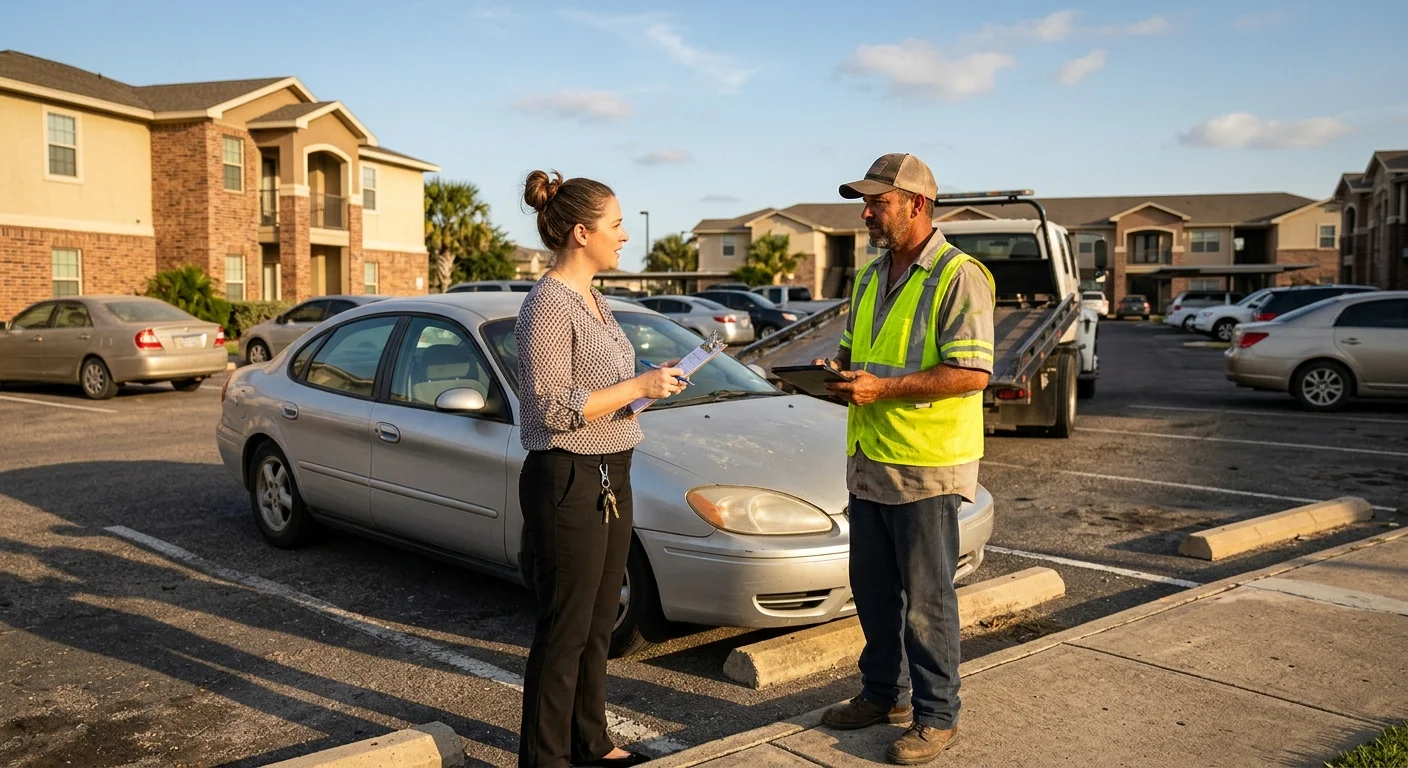
Who can authorize a tow from apartment property
Texas regulates towing under Occupations Code Chapter 2308. TDLR licenses the people who actually operate the truck. Three operator licenses exist: incident management, private property, and consent. An apartment removal without the vehicle owner’s request is a nonconsent tow. The operator you match should hold a private property towing operator’s license for that work.
Cities and counties may add their own rules on nonconsent tows. Under Occupations Code § 2308.201, a political subdivision may require registration of tow trucks that do nonconsent work, even if the truck owner has no office in that city. People with a driver’s license or CDL may also need a local permit to do nonconsent tows in that territory. The regulatory fee for that permit is capped at $15. Lighting rules on the truck cannot be stricter than Title 7 of the Texas Transportation Code.
What the ledger does not confirm is the City of Corpus Christi’s own list of who may sign the authorization: owner, regional manager, on-site staff, after-hours answering service, or contracted security. Do not guess that from a blog. Confirm it with the City of Corpus Christi, with TDLR, and with your management agreement and lease before anyone is dispatched. Ask the operator, on the record, whose signature they will accept at 10 p.m. on a Sunday.
Verify the operator on TDLR’s license search. Search by type, name, license number, city, county, or zip. “Tow truck operators” is the type to select. Municipal extra registration for nonconsent work is separate from that state license. Ask the operator whether Corpus Christi or Nueces County requires a local nonconsent registration for the truck that will enter your lot, and get a yes or a no before the hook.
Search results sometimes mention an “80% rule” for towing. That phrase is not in the verified Texas claims for this site. Treat it as unconfirmed. If a vendor cites it, ask them to point to the TDLR page or the Occupations Code section. If they cannot, do not use it as your policy.
Private property towing from a complex is still a regulated nonconsent job. It is not a favor the brand performs. The operator contracts with you for the dispatch and with the vehicle owner for the bill, unless you and the operator agree otherwise in writing. Confirm that split before the truck rolls.
What to document before anyone is dispatched
Tow trucks do not guess which cars to take. On an apartment lot they go by what you identify. If the plate, stall, color, and building are fuzzy, the wrong Honda gets hooked and you own the complaint. Write the authorization down before you call.
Record the date and time, the person authorizing, their role, and a callback number. Record the stall number, building, and nearest cross street, not just the complex name. “Off SPID near Kostoryz” is not an address. “Building 4, stall 12, gate off Kostoryz” is. Photograph the vehicle so the plate, VIN plate if you can see it, and the stall markings are in the frame. Photograph the posted parking notice as it actually reads. Do not invent wording. If the sign is faded, blocked by a dumpster, or missing, say so in the notes. A later tow hearing can turn on whether restriction signage was there.
Texas gives the owner or operator of a vehicle removed without consent a right to a hearing on probable cause. The request must be filed within 14 days, excluding weekends and holidays, after the vehicle was placed at the storage facility or booted. The hearing is supposed to be held within 21 calendar days of the request. The court filing fee is $20. Photos of parking restriction signage, or a statement that none existed, are on the list of information used in that filing. Your file should already have those photos.
Name the reason in plain words: fire lane, reserved stall, visitor overstay, no permit, inoperable, or abandoned. Those are different jobs. A sedan blocking a dumpster on Leopard is not the same as a car that has sat on blocks behind a Flour Bluff building for a month. For a wreck that is clearly junk, junk car and abandoned vehicle removal may be the better dispatch than a nonconsent hook to a storage facility. Confirm with the operator which path they are taking.
If the owner walks up while the truck is on scene, stop and let the operator apply the drop rules. TDLR states that if the vehicle is not fully hooked, retrieval must be allowed at no charge, with no ownership proof required. If it is fully hooked but has not left the lot, drop fees are capped: $135 for vehicles 10,000 pounds or less, $190 for 10,001 to 25,000 pounds, and $244 above 25,000 pounds. Operators must accept cash, credit cards, and debit cards for those drop fees. Do not send the tenant to an ATM down SPID while the truck sits in your drive aisle.
Keep copies of the operator’s name, TDLR license, truck unit, destination lot, and the quote they gave you. Tenants will call the office the next morning. You want that packet, not a memory of a conversation at the gate.
SPID, Flour Bluff, and downtown complex access
Corpus Christi lots are not interchangeable. A tow that works in a surface lot off Saratoga can stall in a downtown garage or a gated Flour Bluff courtyard. Tell the operator the access, not just the city.
Along South Padre Island Drive, complexes sit tight to retail traffic and short turning radii. Gate codes, speed bumps, and covered stalls matter. A wheel-lift that fits a mid-island row may not clear a low canopy. If the car sits under a carport, say so. If the only way in is a keypad on Weber or Airline, have a staff member at the gate. Do not text a code into a voicemail and hope.
Flour Bluff is a longer run from the Harbor Bridge side of town. Waldron, Laguna Shores, and the streets around Naval Air Station Corpus Christi mix residential lots with trailers, boats, and salt air. A dead car that has sat through a wet week may not roll. Tell the operator if the tires are down or the vehicle is in sand or mud at the edge of the pavement. Padre Island and Park Road 22 add distance and, after a blow, standing water. Do not invent corrosion timelines. Storm surge and coastal flooding are real Atlantic-season hazards from June 1 to November 30. Specific salt-damage clocks for a Corpus Christi parking lot are not verified here, so do not quote one.
Downtown and the near Southside are a different truck problem. One-way pairs, garage height bars, and loading alleys off Shoreline or Leopard can block a full-size wrecker. If the vehicle is in a garage, say the clearance if you have it posted. If you do not, say you do not. Northside and Portland sit across the Harbor Bridge. A storage destination on one side of the ship channel is a long, expensive trip for a tenant who lives on the other. Ask where the car is going before it leaves.
Inland complexes in Robstown and toward Kingsville do not share SPID’s retail crush, but they do share Nueces County roads and night lighting that is thinner than a Staples Street lot. Calallen and Annaville add freeway ramps and longer gate drives. The operator needs the gate, the surface, and the vehicle’s condition. “Apartment in Corpus” is not enough.
How this differs from a blocked driveway call
A homeowner calling about a car across their driveway is not the same job as a manager clearing a 200-stall lot. The blocked driveway call is usually one vehicle, one address, and a person standing in the street. Your call is a nonconsent removal from private property, often after hours, often with other residents watching from balconies.
Authorization is the first split. A driveway call may still involve police or a property owner at a single house. An apartment tow needs the person your company and the operator both treat as authorized for that community. Do not let a night clerk “just send someone” if your policy requires the manager on duty. Put that in writing before the first weekend of the month, when visitor parking fills up.
Billing is the second split. TDLR sets maximum nonconsent towing charges: $272 for vehicles 10,000 pounds or less, $380 for 10,001 to 25,000 pounds, and $489 per unit (maximum $978) above 25,000 pounds. Extra fees that are allowed are narrow: a notification fee up to $50, waived if the vehicle is claimed within 24 hours; an impoundment fee up to $20 only if doors or windows are damaged and documented; and actual law-enforcement or governmental costs. All other add-ons are prohibited. Local ordinances may set lower caps than the state. Whether Corpus Christi has done that could not be confirmed from the sources on file. Ask the City of Corpus Christi and the operator, and keep the answer.
Those caps apply to nonconsent tows. They are not the same as a tow a driver requests. This site’s published light-duty hookup, from $125 for the first five miles, is a brand figure for requested work. Do not mix it with a nonconsent apartment removal. The operator matched to the call quotes that job before doing the work. A driveway relocation around the corner is also not automatically a storage-lot tow. Ask where the car is going.
The private property towing write-up on this site is written for drivers and homeowners fighting or facing a hook. This page is the other desk: you are the person hiring the tow. Keep those files separate in your office so a tenant complaint and a vendor dispatch do not share the same notes.
Confirm the operator, destination, and quote
Before anyone hooks a bumper, confirm three things: who is licensed, where the car is going, and what the bill can be.
Licensed means a TDLR towing operator license for the work, plus any local nonconsent registration the city or county requires. Search the license. Do not take a door magnet as proof. Every operator in the network we use is licensed and insured. Quick Tow is not the licensee and does not hold the truck permit.
Destination means a named vehicle storage facility, not “the yard.” City of Corpus Christi police impound location, hours, and retrieval steps could not be verified from city pages. Do not publish a lot address from memory. Get the operator’s facility name and phone, then tell the tenant to call that lot and TDLR. To pick a vehicle up, TDLR says the owner needs photo ID, proof of ownership (license matching registration, insurance card, title, tax collector’s receipt, lease or rental agreement, or TDLR-provided forms), and payment of towing and storage. Access to ownership documents and personal property is free and must be given within one hour during the facility’s access hours. Facilities open around the clock must provide that access within one hour at any time. Others must do it within one hour between 8 a.m. and midnight Monday through Saturday, and 8 a.m. to 5 p.m. Sunday.
Quote means the nonconsent cap that fits the vehicle’s weight, plus storage. TDLR lists standard storage at $20 per day or part of a day for vehicles 25 feet or less, and $35 for longer vehicles, and also states 2023 adjusted figures of $22.85 and $39.99. Confirm the current number with TDLR and with the lot before you tell a tenant what they will pay. A facility cannot charge for multiple days if the vehicle was stored less than 12 hours total. Filing a TDLR complaint does not replace a tow hearing. Both are allowed. Missing the 14-day hearing window forfeits the hearing.
If the operator cannot name the license, the lot, and the cap, do not authorize the hook. A towing company for apartments is only useful if you can explain the tow at 8 a.m. to a resident who just got off a night shift at the port.
When to call us
Call when you have the vehicle identified, the authorization in hand, and you need a licensed private-property operator on a Corpus Christi or Coastal Bend apartment lot. That includes fire-lane and reserved-stall removals, inoperable cars that have to leave the property, and junk units that no longer belong in a tenant stall. Call us at (361) 967-8088 and we’ll connect you with a licensed operator.