A nail in a La Palmera stall is one job. A shredded tire on SPID at Waldron is another. One can stay put for a spare swap. The other should not roll another mile. This page is that call: mobile tire repair near you, or a tow to a shop.
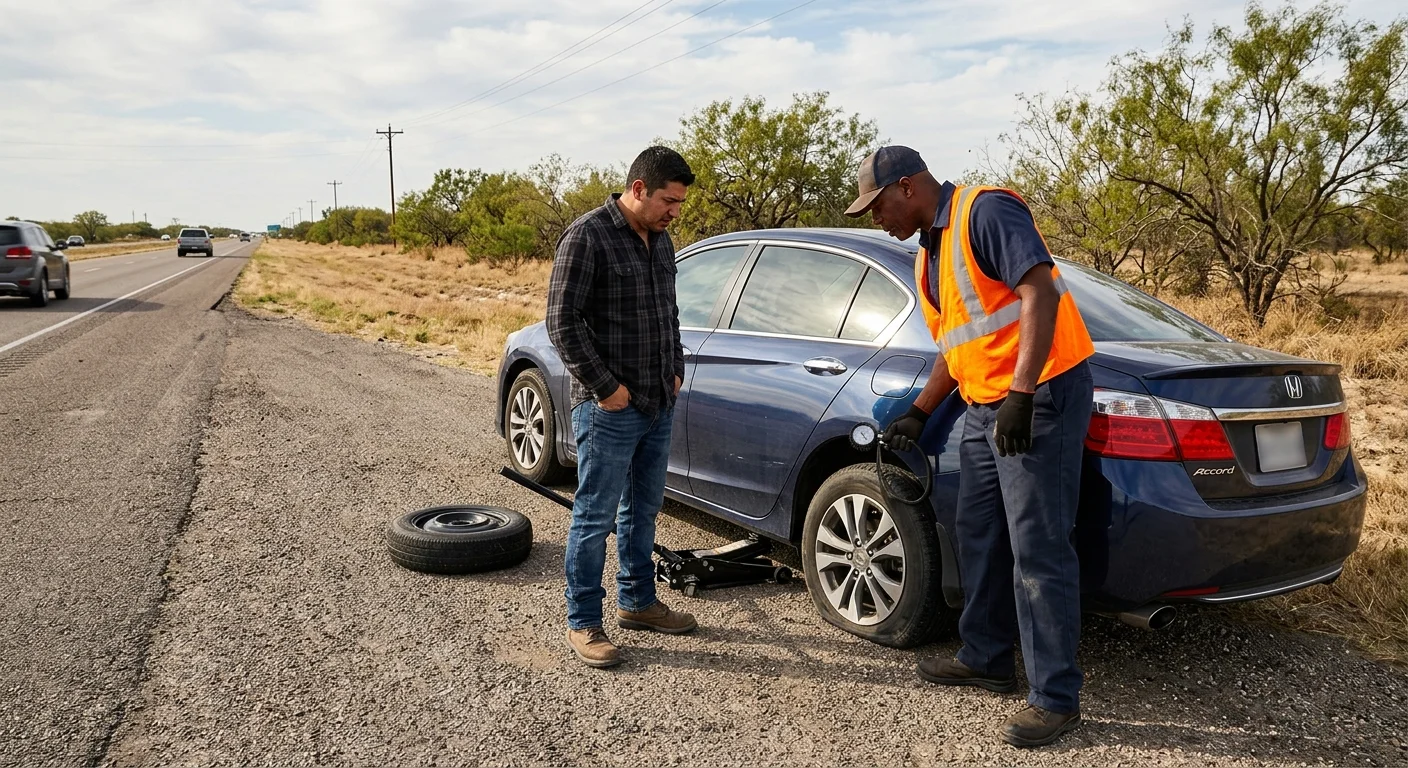
What a mobile tire call can usually handle
People type mobile tire repair near me when they want a tire shop that comes to you. That might be a driveway in Calallen, a lot off Leopard, or a shoulder on SH 358. Quick Tow is a referral service. We connect you with independent, licensed operators. We do not repair tires, and we do not own a tire truck.
What the matched operator can do on site is not a published list. Ask before anyone is sent. Treat every capability as unconfirmed until that operator says they have the tools, the size, and a safe place to work.
A usable spare is the cleanest roadside tire job. If the donut or full-size spare holds air, and the jack point and wheel lock key are there, many operators can swap the wheel in a parking stall or on a wide, paved shoulder. That is roadside assistance, not a shop repair. You leave on the spare and take the damaged tire to a shop when you can.
Some operators carry plugs, a portable air tank to refill a tire, or a common passenger size. Some show up to change the wheel you already have and nothing else. A slow leak from a nail in the tread is the kind of injury they may be willing to work with on site. A torn sidewall is not. Do not assume a plug is a real inside repair. If the operator cannot confirm what they will do, you do not have a plan yet.
Home driveways, apartment lots, and workplace lots are usually easier than a live lane. The operator has room to set out, jack the car, and keep traffic off the work. Someone can come change a tire at home if the matched operator does that work and the car is on firm, level ground. Soft sand, a steep drive, or a stall boxed in by other cars can turn a simple swap into a short tow.
If you searched 24 hour tire service near me because the shops on Saratoga or along SPID are closed, say that on the call. The phone line takes calls 24/7. Whether an operator can come for a tire at that hour is their answer, not a promise from us.
When a flat still needs a tow to a shop
Our guide on a flat tire in Corpus Christi covers what to do in the moment: get out of the travel lane if you can, stay visible, and do not kneel on the traffic side of the car. This page is the next decision. Stay and work the tire, or move the vehicle.
Plan on a tow when any of this is true. You have no spare, or the spare is flat too. Two tires are down. You can see a bent wheel from the curb. The sidewall is slashed or chewed. Wires are showing. You already drove on it for a stretch of SPID, Waldron, or Park Road 22. The car is AWD and a spare would leave the tires unmatched. The vehicle is sitting in sand on Padre. The shoulder is too narrow to jack the car without putting someone in a lane.
A shop can dismount the tire, look at the inside of the casing, and replace a wheel if the rim is cracked. Roadside gear is limited. If the operator says they cannot make it safe to drive, that is the answer. Do not bargain for a plug on a destroyed tire.
If the car cannot roll, that is emergency towing. The operator quotes the tow before they hook up. Our published light-duty hookup starts at $125 and covers the first five miles. Mileage past that is roughly $3 to $5 per mile. Those are this site’s published figures, not a market survey and not a statutory cap. The operator you are matched with quotes the price they will charge. A tow you request yourself is not capped by TDLR’s nonconsent maximums. Those caps apply to tows without the owner’s consent.
Run-flats, low-profile wheels, and sensors add shop work that a roadside call may not finish. We have not verified which operators reset TPMS at the scene. Ask. If they cannot, the car still needs a shop even after the spare is on.
If you are stuck on the split between a roadside call and a tow, roadside assistance vs towing in Corpus Christi walks that choice in more detail.
Details to share before anyone is dispatched
The more precise you are, the less chance the wrong truck shows up.
Start with the town: Corpus Christi, Portland, Flour Bluff, Padre Island, Robstown, or Kingsville. Then the road and the direction. On SPID, the last exit you passed matters. Weber, Staples, Airline, Waldron, and Flour Bluff Drive are not interchangeable. On the Island, give Park Road 22 and the nearest beach access, hotel, or lot. In town, give a cross street and which side of the lot. “Near me” is not an address.
Give the vehicle: year, make, model, and whether it is AWD, a pickup, a van, or a lowered car. Read the tire size off the sidewall if you can, something like 225/65R17. Say if you have a spare, a jack, and the wheel lock key. Say if the spare is a donut. That changes how far you should drive after the swap.
Describe the damage in plain words. A hiss you can hear. A nail in the tread. Sidewall chewed. Rim sitting on the pavement. Already driven on it for two miles. That last one changes the job, because the casing may already be unsafe.
Say if you are in live traffic or fully off the road. Texas’s Move Over law, Texas Transportation Code § 545.157, requires other drivers to change lanes or slow down when a permitted tow truck is stopped with proper lights. You still stay belted in the vehicle if the spot is exposed, or you get well away from the travel lanes if you can do that safely. Do not stand in the lane to photograph the tire.
If it is between 10 PM and 6 AM, say so. Our published after-hours surcharge is $25 to $50 on top of the job. Roadside calls are published from $75. None of those numbers is a guaranteed total. Confirm the quote with the operator before work starts.
You can check that a tow operator is licensed through TDLR’s license search. Search by name, city, or license number. Every operator in the network is licensed and insured.
Where this happens on SPID, Flour Bluff, and Padre Island
Corpus Christi is not one road. The same flat plays out differently by stretch.
SPID, SH 358, is the high-speed spine from the Harbor Bridge run out toward the Island. Shoulders get thin near the retail stretches and the overpasses. A spare swap in a La Palmera stall is one job. The same tire on the eastbound shoulder at Waldron, with Gulf traffic at highway speed, is a different risk. If there is no wide, paved refuge, a short tow to a shop off the feeder is often the safer call. Do not stand on the traffic side of the car to inspect the tire. Get the vehicle out of the lane first, even if that means a tow instead of a plug.
Flour Bluff sits on NAS-Corpus Christi traffic, Waldron Road, and the run toward the Island. Shell, sand, and construction debris show up in tires here more than they do inland toward Robstown. Lots along Waldron or at a workplace give an operator room to work. The two-lane stretches do not. Salt air does not change the repair-versus-tow rule on its own. A rim that already looks crusted may not take a clean bead at the roadside. Ask the operator to look at the wheel, not just the rubber. If the bead will not seat, the car goes to a shop.
Padre Island and Park Road 22 add distance and sand. A slow leak in a lagoon-side lot can wait for a mobile tire call if the operator can reach you and you have a spare. A car already sitting in beach sand is often a recovery plus a tow, not a plug. The JFK Causeway is a long, exposed run with little room to work. If the tire failed on the span or at the base, treat it as a highway job. Shops are back on the mainland. Confirm whether the operator is coming to repair, to swap a spare, or to tow you off the Island. Those three jobs are not the same truck, and they are not the same quote.
Portland across the Harbor Bridge, and the Northside, add bridge traffic and tight shoulders. Inland toward Robstown and Kingsville you often have more shoulder and fewer lights. Say which town you are actually in. A Padre Island call and a Robstown call are not the same drive, and they are not the same shoulder.
Confirm the plan and the quote before work starts
Before anyone jacks the car, you should hear a plan in one sentence. Spare swap. Attempt a roadside repair. Or tow to a shop you name.
If the plan is a repair, ask what they will do, and what happens if it will not hold. If they cannot confirm they have the size, the spare, or the tools, do not wait on a maybe. Switch the job to a tow.
If the plan is a tow, agree on the destination. A tire shop you already use on Saratoga, on SPID, or in Portland. Or the nearest shop the operator can reach. You contract with the operator, and you pay that operator directly.
Our published rates, for context only. Roadside calls start at $75. Light-duty hookup starts at $125 for the first five miles. Extra miles are roughly $3 to $5. After-hours, 10 PM to 6 AM, add $25 to $50. The operator’s quote is the number that matters. We do not set their price. Do not treat a published starting figure as a billed total.
People also ask what a mobile tire change should cost, and what the average shop repair runs. We have not verified third-party patch or replacement prices for Corpus Christi shops. Those figures are not in our claims ledger, so we will not invent them. Ask the operator for the roadside portion. Ask the shop for the tire, the mount, and any sensor work.
Confirm how they take payment before work starts. For a tow you requested, that is between you and the operator.
If the scene is not safe, skip the debate. Get the vehicle off SPID, off Park Road 22, or out of the sand. Deal with the tire at a shop once the car is on solid ground.
When to call us
Call when you need a licensed operator to swap a spare, look at a flat, or tow the vehicle to a shop. That includes a driveway in Corpus Christi, a shoulder on SPID, Flour Bluff, or Padre Island, and a night when the tire shops are closed. Call us at (361) 967-8088 and we’ll connect you with a licensed operator.