The wheel is cocked, the bunks are still loaded, and you’re somewhere between a Rockport ramp and SH 35. Boat trailer axle trouble here is a fork: a tire the operator can change on site, or a trailer that won’t roll and has to be recovered. Describe the scene once, clearly, then let a licensed operator size the truck.
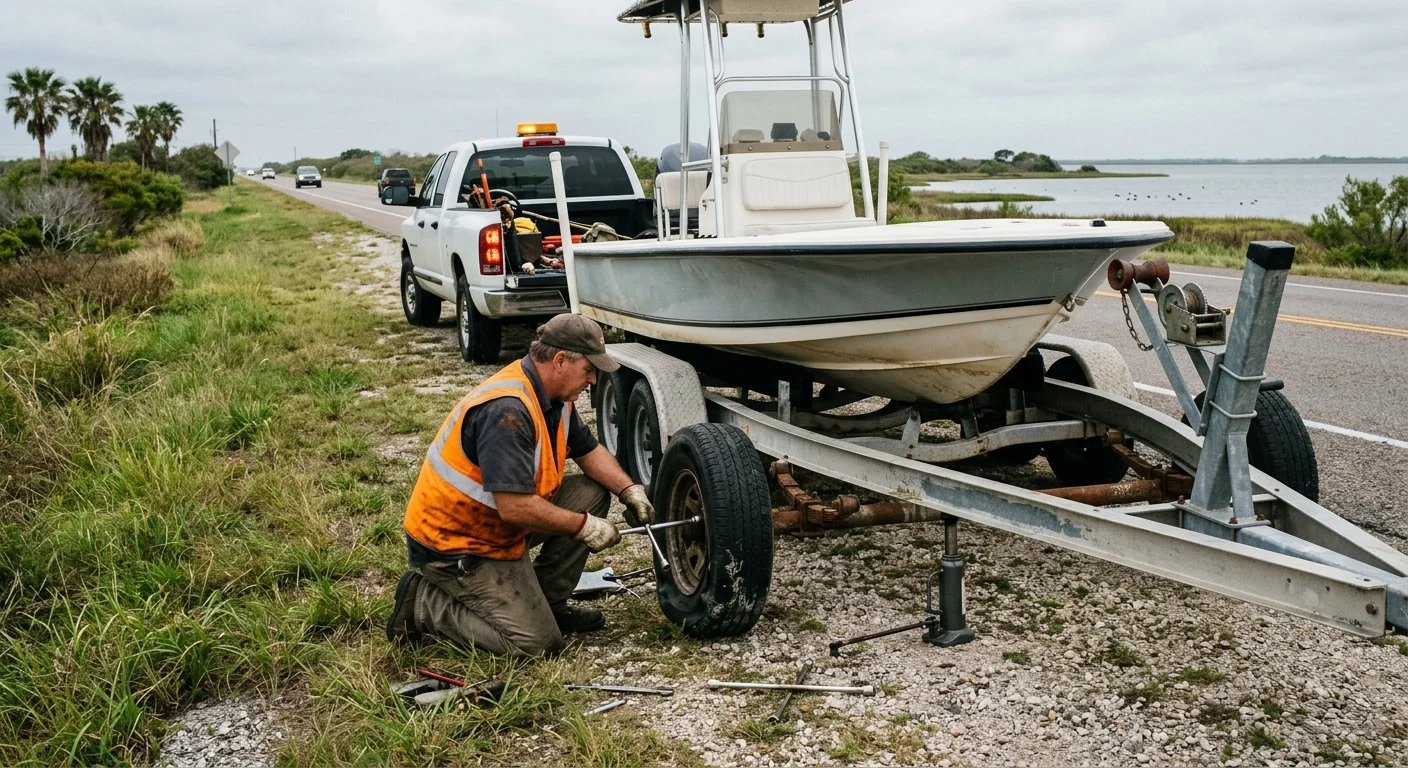
Stop and describe the trailer’s position
You’re looking at a trailer that won’t track straight. Before anyone talks hubs or spares, pin the location. Rockport sits on Live Oak Peninsula, with a harbor, a beach park, a bridge north, and SH 35 through the middle.
Name the road first. SH 35 is the spine through Rockport-Fulton. South of downtown it runs toward Aransas Pass. North it becomes the Fulton stretch, then the Copano Bay Bridge toward Lamar and Holiday Beach. SH 188 heads west toward Sinton. FM 1781 follows the Copano side of the peninsula. If you’re on the Key Allegro bridge or the loop around Little Bay, say that. Those spans are short, with little room to stage a truck.
If you launched, name the water. Rockport Harbor, Fulton Harbor, Cove Harbor, and Rockport Beach each have their own apron, grade, and weekend traffic. A trailer that failed coming up the ramp is still on a slope, with the boat on the bunks and the tongue on the hitch. A trailer on Market Street or Business 35 is in town traffic. A trailer on the Copano Bay Bridge needs hazards on and people inside the tow vehicle. Walking that span to inspect an axle puts you in travel lanes with no real shoulder.
Texas Move Over law applies when a permitted tow truck is stopped with proper lights. On a highway with two or more lanes in your direction, drivers must leave the lane closest to that truck, or slow at least 20 mph under the posted limit when that limit is 25 mph or more. A first offense carries fines from $500 to $1,250. The operator needs a true pin so they can set lights and cones.
Turn on hazards. Keep people on the safe side of the trailer. If the wheel sits in a travel lane, say so. If the boat is still strapped, say so. If you’re still on the ball, say whether you can creep forward a few feet or you’re locked in place.
Tell the operator what happened to the axle
A boat trailer axle failure in Rockport is not one sound. Tell the operator what you saw and heard, in order.
A tire that went flat and stayed centered is often tire and wheel work. A tire that shredded, then the hub started smoking, is a different call. A wheel that walked outward, a drum that sits at an angle, or a trailer that suddenly sat down on one corner is axle or bearing trouble. If you heard a bang, then grinding, then the trailer pulled hard, say that sequence. If grease is flung up the fender, say that. If a wheel is gone and the spindle is on the pavement, lead with that.
Stay off the pavement under the trailer on SH 35. You’re describing, not repairing. From a safe spot, note which side failed. Note whether the trailer is still hitched. Note whether the boat shifted on the bunks. If the tongue jack is down and the tow vehicle is unhooked, say that. If the coupler is still on the ball and the safety chains are tight, say that too. A trailer still on the hitch behaves differently when an operator lifts or winches a corner.
Mention the water if you just left it. Trailers that live on Aransas Bay, Copano Bay, or in a slip at Cove Harbor see salt spray on hubs and magnets. That doesn’t give you a failure date. It does tell the operator this may be a seized hub after a launch, not a fresh highway puncture. If the brakes were wet, then a wheel locked, include the launch name. The sequence of noise and lean is the useful part.
If another vehicle is involved, or the trailer swept into a lane, call 911 first. For a trailer that failed on its own, keep the mechanical picture short: single axle or tandem, which axle, which side, boat on or off, and whether the remaining wheels can roll. That is how the right truck gets sent for disabled boat trailer towing.
Separate roadside tire work from trailer recovery
This is the split that matters on the call.
Trailer roadside assistance in Rockport makes sense when the structure is intact. The wheel is still on the hub. The axle tube looks straight. The trailer sits level aside from the flat. You have a spare that matches, or you need a tire changed on a lot off Business 35, at Rockport Beach, or in a harbor parking stall. That is a roadside assistance call. The operator you’re matched with treats it like other trailer tire work, with a boat as a tall, shifting load.
Recovery is the call when the trailer can’t roll safely. The axle is bent. The hub is off. A tandem is down on one corner and the remaining tires can’t carry the boat. The frame is sitting on a drum. The wheel is in the ditch and the spindle is bare. On those jobs you need RV and trailer towing sized for a loaded bunk trailer.
Room on the ground changes the split. A wide lot at Rockport Beach can hold a tire change. The Copano Bay Bridge doesn’t give you a workspace. The Key Allegro bridge doesn’t give you a shoulder you want to occupy. Coming up a wet ramp at Fulton Harbor, a failed axle can leave the boat and trailer across the apron. That is recovery, even when the path is a hundred feet of concrete.
If you can creep into a nearby lot or a wide pull-off, do that and stop. Then describe the new pin. Dragging a crabbing trailer down SH 35 toward Aransas Pass, or south toward Corpus Christi, can fold a fender into the hull.
If you’re already in Fulton when the wheel lets go, the same split applies. Our guide to a breakdown in Fulton covers that short stretch north of Rockport. The equipment question stays the same: a spare and a sound hub, or a trailer that has to be loaded because an axle is finished.
Share the boat, trailer, and hitch details
Operators size boat trailer towing in Rockport TX from three stacks: the boat, the trailer, and whatever is pulling it.
Give the boat’s length as well as you know it. Add hull type if you know it: bay boat, center console, skiff, or pontoon. Say whether the outboard is still on the transom. A motor hanging off the back changes tongue weight. Say if the boat is loaded with batteries, fuel, and ice, or stripped for the shop. You don’t need a scale. You need an honest picture.
On the trailer, say single axle or tandem. Bunk or roller. Brakes if you know disc or drum. Spare mounted or missing. Width over the fenders. If a fender is already folded into the tire, say that. Confirm current trailer tag rules with TxDMV or the Aransas County tax office. For the tow itself, the operator needs the physical trailer: can it roll, and what sits on the bunks.
On the hitch, share ball size if you know it. Say whether you’re on a straight coupler or weight-distribution bars. Say whether a camper or travel trailer is already in the combination. Pulling a boat behind an RV trailer changes length and swing in a Rockport Harbor aisle. Tell the operator if a second unit is in the string so they bring a truck that can work around it.
If the boat is off the trailer, say so. A bare trailer is a lighter drag. A boat still strapped is the common case after a Rockport launch. Mention straps, winch cable, and whether the bow is in the stop. If the hull shifted, the operator needs that before they lift a corner.
For metro-wide trailer questions beyond this axle case, use our boat trailer towing guide for Corpus Christi. This page stays on Rockport pickup: harbor, SH 35, Fulton, Copano, and the ramp.
Confirm equipment, destination, and the quote
Once the operator has the scene, the failure, and the load, stay on the line for three more items.
Ask what they are bringing. A loaded bunk trailer with a center console on it needs gear meant for that weight and width. A flatbed can be a clean way to move a short trailer if the axle won’t roll. A longer boat may need trailer recovery, a dolly under the damaged side, or a heavier truck. Heavy-duty work is quoted separately from our light-duty floor. Ask whether the quote is for a loaded boat trailer. Ask whether they are bringing a flatbed, a wrecker, or extra wheel support.
Name the destination. A shop on SH 35 in Aransas Pass is a different mileage run than a house in Key Allegro, a lot west on SH 188, or a drop toward Corpus Christi. Our published light-duty hookup starts at $125 for the first five miles. Mileage after that is roughly $3 to $5 per mile. After-hours work between 10 p.m. and 6 a.m. carries a published surcharge of $25 to $50. Those are this site’s published figures. They are a starting point. The operator matched to your call quotes the job before doing the work. A tow you request is a consent job. Texas nonconsent rate caps apply to tows done without the owner’s consent, which is a different kind of call.
If the destination is a repair bay, ask whether they can receive a trailer that won’t roll. Some shops want it dropped outside. Say if you need the boat and trailer kept together. Say if the tow vehicle is staying with you or leaving.
Hear the number before anyone hooks a chain. Pay the operator directly. Quick Tow matches you with independent, licensed operators. You can verify a tow operator through TDLR’s license search. Every operator in the network is licensed and insured.
If you only needed a tire and the spare is on, confirm that is all you are buying. If the axle is done, confirm they are recovering the trailer. Axle replacement belongs in a shop. The shoulder, the ramp, and the harbor aisle are for getting the rig off the travel path.
When to call us
A disabled boat trailer with a bent axle, a missing wheel, or a hub on the pavement is a recovery job for a licensed towing operator. If you’re sitting on SH 35, at a Rockport ramp, or on the Fulton stretch and the trailer won’t roll, make the call. Call us at (361) 967-8088 and we’ll connect you with a licensed operator.