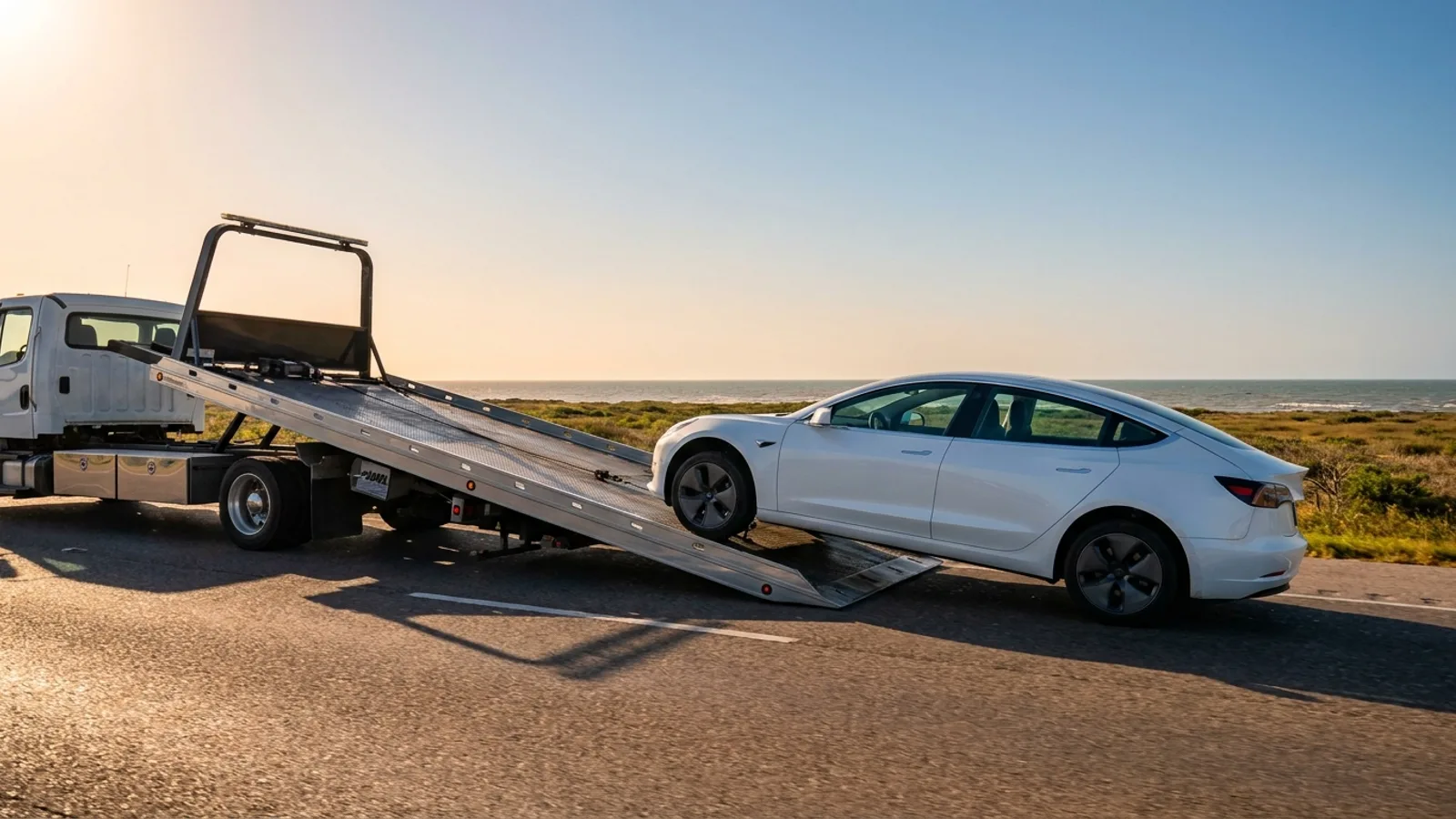
An electric car or Tesla should always move on a flatbed with all four wheels off the ground, never flat-towed behind another vehicle. Most EVs have no true mechanical neutral that fully disconnects the drive wheels from the electric motor, so spinning them on the pavement can damage the drivetrain and the regenerative braking system. A flatbed avoids that risk completely. Arrival across the Coastal Bend typically runs 30 to 45 minutes. Call (361) 967-8088 and a dispatcher gets a flatbed moving toward you, 24/7.
Can you flat-tow an electric car or does it need a flatbed?
An electric car needs a flatbed, not a flat tow and not a dolly. Flat towing drags all four wheels on the ground behind a truck, which spins the drive axle and the electric motor connected to it. Dolly towing lifts only the front or rear wheels while the other axle stays on the road, which is just as risky if that axle drives the motor. A flatbed is the only method that lifts every wheel off the pavement, so nothing turns and nothing feeds current back into a system that was not built for it. Most EVs simply do not have the kind of mechanical neutral a gas transmission has, so there is no safe way to disengage the wheels from the motor on the roadside. Owner’s manuals, including Tesla’s own manual, direct transport on a flatbed and warn that other towing methods can cause damage. That is why the EV and Tesla towing trucks in the Quick Tow network are dispatched specifically for these calls.
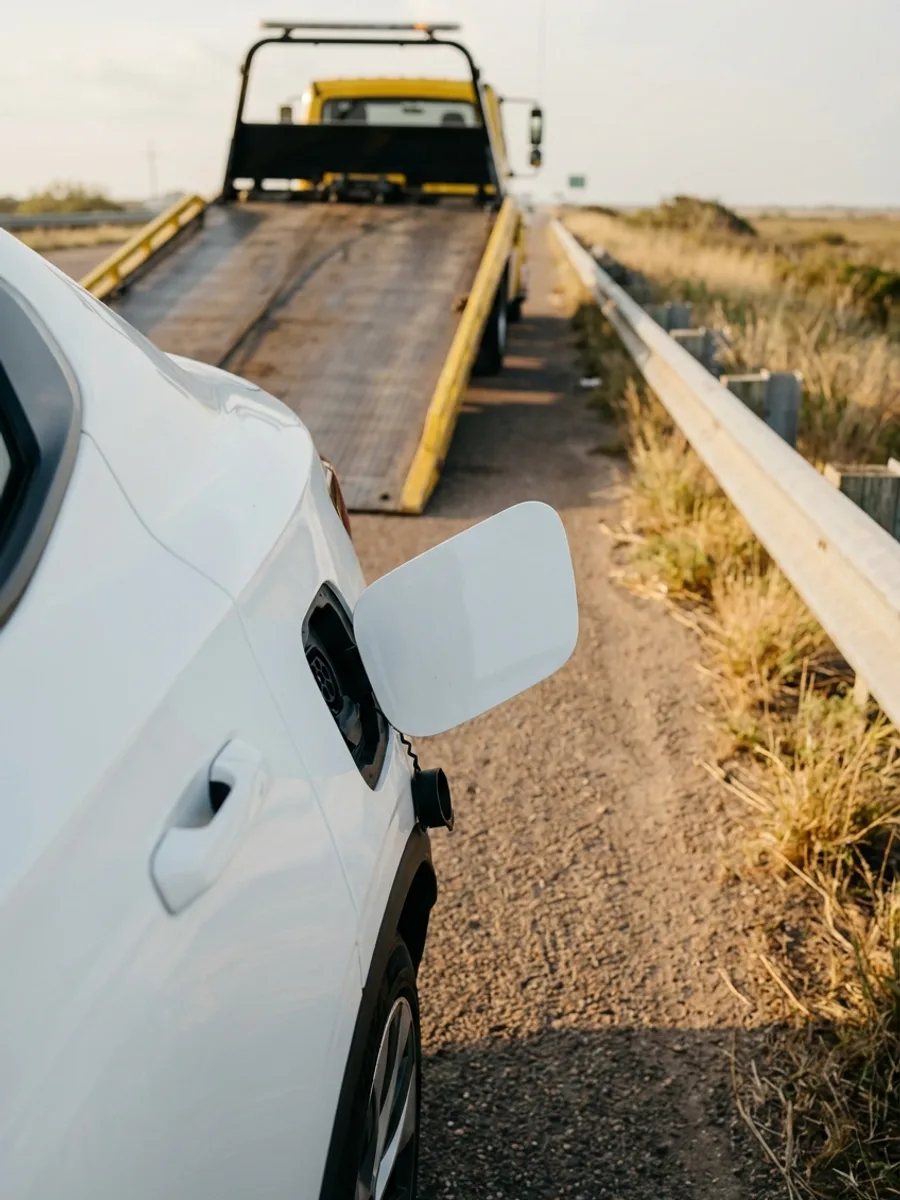
How do you tow an electric car without damaging it?
The right way to tow an electric car starts with getting off the travel lane and calling for a flatbed built for EVs. Here is the order that keeps the car and everyone nearby safe.
- Pull as far onto the shoulder as possible and turn on hazard lights.
- If the owner’s manual lists a “transport” or “tow” mode, put the car in it before the truck arrives.
- Do not let anyone flat-tow or dolly-tow the car, even for a short distance.
- Note the nearest cross street, exit number, or mile marker for the dispatcher.
- Call (361) 967-8088 and say it is an electric vehicle so a flatbed tow gets sent instead of a standard hook-and-chain rig.
Why does an electric car have to go on a flatbed?
An electric car has to go on a flatbed because turning the wheels turns the motor, and that motor has no gas-style neutral to shut it off from the drivetrain. In a gas car, neutral physically disconnects the engine from the wheels, so towing on the ground is fine. In most EVs, the wheels stay linked to the motor and the regenerative braking hardware at all times. Roll those wheels down the highway for miles and the motor spins along with them, which can overheat components built for driving, not towing. A dolly does not solve this either, since the axle left on the ground is often the drive axle, and it causes the same damage a full flat tow would.
What about the 12-volt battery, and can you jump an EV?
Yes, electric cars still carry a small 12-volt battery, separate from the main battery pack, and it runs the door locks, the touchscreen, and the onboard computers. When that 12-volt battery dies, the doors and charge port can lock up and the car looks and acts completely dead, even though the main battery might be fine. That is often a simple 12-volt jump-start situation, not a full tow, and it is exactly what roadside assistance calls are for. The salt-laden Gulf air around Corpus Christi corrodes 12-volt terminals faster than it does inland, so this failure shows up more often here than in drier climates. If you have a dead 12-volt battery and the car will not wake up, mention that when you call so the right equipment shows up first.
How heavy is an electric car, and does that change the tow?
Electric cars run heavier than comparable gas cars because the battery pack itself weighs a lot. A compact EV crossover comes in around 4,400 pounds, an electric pickup like a Lightning runs roughly 6,500 pounds, and a large electric truck like a Hummer EV can push near 9,000 pounds. That extra weight means some EVs need a rig with more lifting and hauling capacity, which is where heavy-duty towing equipment comes in for the bigger trucks and SUVs. A dead or low charge also cannot be fixed with a can of fuel the way an empty gas tank can, so a stranded EV usually needs a long-distance tow to the nearest working charger rather than a five-minute fix on the shoulder. The run up I-37 toward San Antonio is roughly 140 miles with limited fast chargers along the way, so range anxiety genuinely strands EV drivers on that stretch. Nueces County’s EV presence keeps growing too, with the Tesla lithium refinery corridor near Robstown on US-77 bringing more electric vehicles through the area.
What happens if an electric car is wrecked or flooded?
A wrecked or flooded electric car carries a fire and thermal-runaway risk in its battery pack, so it gets handled with more caution than a standard breakdown. Saltwater intrusion or a hard impact can damage battery cells in ways that are not visible from the outside, and a damaged pack can heat up hours or even days after the incident. A flooded or crashed EV is kept away from structures and other vehicles where possible, and the operators in the Quick Tow network move it on a flatbed just like any other electric vehicle recovery. Corpus Christi’s coastal flooding during storms makes this a real scenario for local drivers, not a hypothetical one, so calling it in as an EV the moment it happens helps the right truck and the right precautions show up together.
Frequently asked questions
Can you tow a Tesla in Corpus Christi?
Yes, Teslas get towed across Corpus Christi and the Coastal Bend on flatbeds equipped for electric vehicles. A dispatcher routes the call to an operator running the right equipment as soon as you mention it is a Tesla.
Can you flat-tow or dolly-tow an electric car?
No, neither method is safe for an electric car. Both leave at least one set of wheels turning the drive motor, which can damage the drivetrain and the regenerative braking system, so a flatbed is used instead.
Do you tow electric cars that have run out of charge?
Yes, a car with a dead battery pack still gets moved by flatbed to a charging station or a preferred location. A depleted EV cannot be refueled roadside the way a gas car can, so transport is the fix.
Can you jump-start an electric car?
Often yes, if the issue is the separate 12-volt battery that runs the locks and electronics rather than the main battery pack. That call goes out as a roadside jump, and if the car still will not respond, it gets moved by flatbed instead.
How much does it cost to tow an electric car in Corpus Christi?
Cost depends on the vehicle’s weight, whether it needs standard or heavy-duty equipment, and the distance to the destination. Every price is confirmed as a flat rate before the truck is dispatched, so call (361) 967-8088 for an exact number on your situation.
If your EV or Tesla needs to move right now, don’t risk it on a flat tow or a dolly. Call (361) 967-8088, a flatbed built for electric vehicles gets sent your way, and the price is confirmed before the truck ever moves.