A crash on US 77 near Kingsville is not the same job as a stalled car in a Corpus Christi lot. The operator who can take it needs the scene, the damage, and a real drop-off, not a vague “somewhere south of town.” Share those details and we can match you with a licensed recovery operator instead of sending the wrong truck.
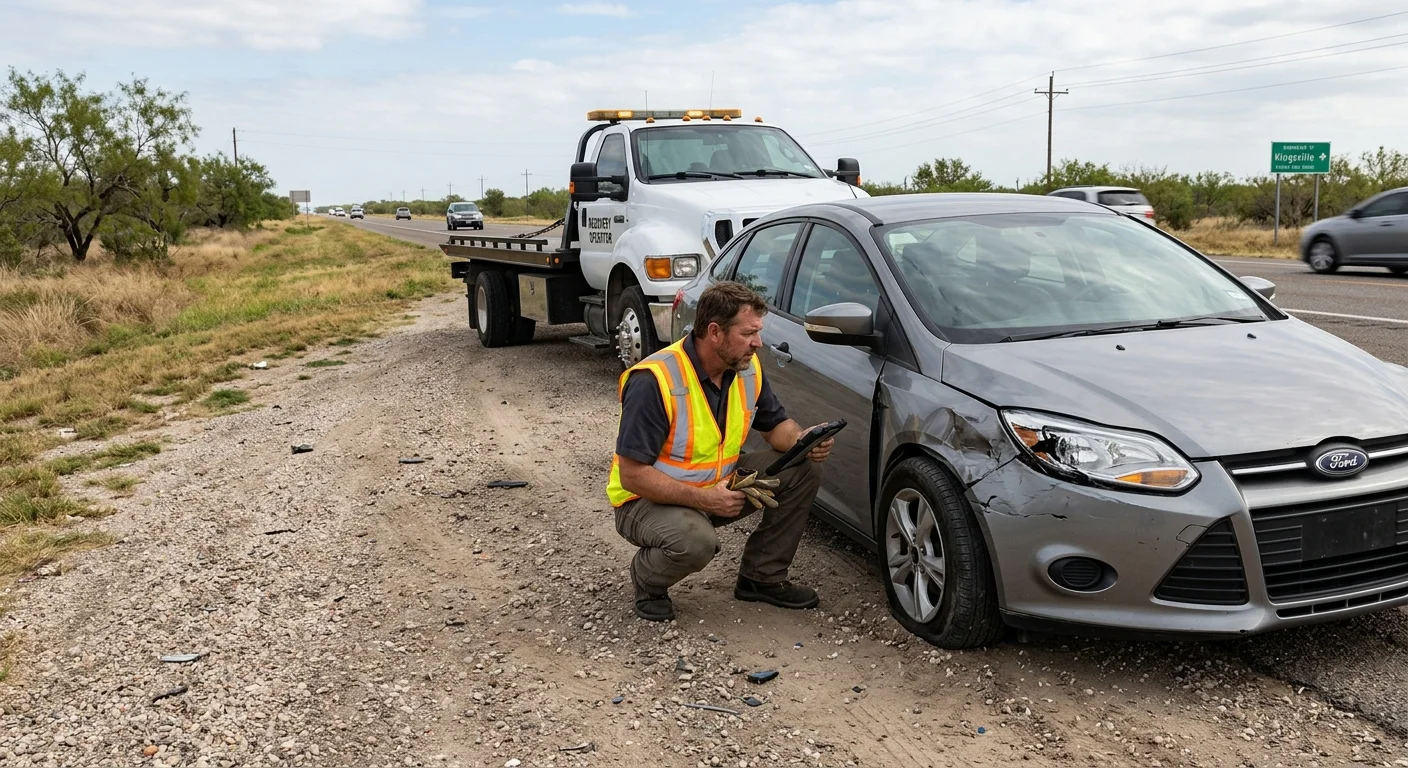
Share the exact location and road position
“Near Kingsville” is not a pin. US 77 runs north-south through Kleberg County, with Bishop to the north and the King Ranch country opening to the west. A sedan in the northbound shoulder south of Bishop is a different run than a troca in the median by the US 77 Business split, or a car on Caesar Avenue in town by Texas A&M-Kingsville. Name the highway, the direction of travel, and the nearest cross street or mile marker you can see.
Say which side of the pavement you are on. Shoulder, gore, median, or a side road off the mainline all change how an operator approaches. If you passed the FM 1717 area, the Business 77 turn into town, or a ranch gate you can still read, say so. If you are closer to NAS Kingsville traffic than to downtown, say that too. Inland Kleberg County is not Flour Bluff, and it is not the Harbor Bridge. The road is faster, darker at night, and farther from Corpus Christi shops.
Stay in the vehicle if it is safer there, with seat belts on and hazards going. If you can get out, get well off the travel lane and keep people on the safe side of the guardrail or ditch. Texas’s Move Over law covers stationary tow trucks that are using proper lights. Other drivers must vacate the lane closest to that truck when there are two or more lanes the same way, or slow to no more than 20 mph under the posted limit when that limit is 25 mph or more. A first offense is a misdemeanor with a fine from $500 to $1,250. You cannot control other drivers. You can keep your own people out of the lane.
If an officer is already on scene, ask which agency has the call and whether the vehicle is free to leave with an owner-requested tow. A police-directed removal is a different kind of job than one you request yourself. Do not guess the lot. City of Corpus Christi impound details could not be confirmed from primary city pages for this site, and Kingsville is not that city. Ask the officer, or call the agency that stopped you, before you assume the car is going to a Corpus Christi pound.
A breakdown on this stretch is its own problem. If you were already looking at that corridor, our US 77 guide from Bishop to Kingsville covers the same road in ordinary trouble, not crash work. For the crash itself, the pin and the lane position come first.
Describe vehicle damage and wheel condition
The operator needs to know what still rolls and what will drag. A car that can be steered onto a bed is one job. A car with two collapsed corners, a locked column, or a wheel folded under the fender is another. Walk the vehicle only if it is safe. Then say what you see in plain words.
Name the corners. Driver front, passenger rear, both. Say if a tire is flat, off the rim, or pointed the wrong way. Say if a wheel is missing, if the axle looks bent, or if the car sits on a rotor. If airbags are out, the hood is up, or fluid is on the pavement, say that. Do not diagnose the frame. Do not promise the car is “fine to tow.” Just report what a person standing ten feet away can see.
Drivetrain matters. An AWD crossover, a dually, a lowered car, or a motorcycle does not load like a stock sedan. If it is a work troca, say the bed is loaded or empty. If it is a trailer still coupled, say so. Heavy equipment and big trucks are not covered by this site’s light-duty published floor. Those get a separate quote from the operator who can actually take the weight.
This is why accident work is not a standard hook from a parking space. A rolling disabled car and a crashed car are different matches. If you want that split in writing, read accident recovery versus a standard tow. The short version for the call: wheels, leaks, and whether the car still rolls in a straight line.
Take photos if you can do it from a safe spot. A shot of each corner, one of the undercarriage if it is visible, and one that shows the car against the road help the operator decide the truck. Do not stand in the travel lane for a picture. Do not crawl under a car that is on a slope or a cracked shoulder.
If the vehicle is a motorcycle, say whether it is on its side, on the kickstand, or in the grass. If it is an EV, say that before anyone hooks a wheel-lift they did not plan for. None of that is a guarantee about method. It is how you keep the wrong truck from driving out to Kleberg County.
Explain whether the vehicle left the pavement
Off the asphalt is the detail that turns a tow into a recovery. A car still on the shoulder of US 77, even with a smashed nose, is not the same as a car in the ditch, in the median, against a fence, or nose-down in the grass toward a ranch fence line. Santa Gertrudis drainage and the bar ditches along 77 hold cars after a rain in a way a dry Corpus Christi curb does not. Say if all four wheels are on pavement, if two are in dirt, or if the whole vehicle is off the road.
Say the surface. Dry grass, wet clay, caliche, standing water, or a slope toward the fence. Say how far. “Ten feet off the fog line” is usable. “In a field” is not. If you went through a cable barrier or a sign, say that. If the car is high-centered on a culvert, say that. The operator decides whether a winch, a flatbed, or a decline is even possible. We do not promise a winch, a rotator, or a damage-free pull. Accident recovery and winch-outs are the service you are asking for when the car left the road. The matched operator still has to confirm they can take that scene.
Do not try to yank it out with another truck, a strap from a friend’s troca, or a shovel in the dark. That is how a second vehicle ends up in the same ditch. Stay clear of traffic. If the car is leaking fuel or you smell it, get away and tell 911. Keep bystanders off the slope.
Night and weather change the same pin. US 77 south of Bishop has long unlit stretches. After a Coastal Bend downpour the ditch is a different job than it was at noon. Hurricane season on the Atlantic calendar runs June 1 to November 30. This inland Kingsville scene is not a Padre Island surge, but rain and wind still matter to the person backing a bed toward a slope. Say if it is raining, if the shoulder is soft, and if other cars are still using that lane.
If the vehicle never left the pavement and the wheels still turn, say that clearly too. Then the match may be closer to a careful highway tow than a recovery. Guessing either way wastes a drive.
Choose a safe and confirmed destination
“Just take it” is how cars sit on a lot you did not pick. Before the truck moves, you need a place that will take the vehicle tonight. A body shop in Kingsville, a dealer, your driveway, an insurer’s lot, or a shop in Corpus Christi are all real answers. An unnamed “shop on the way” is not.
Call the destination if you can. Confirm they are open, they have a key drop or a night gate, and they will accept a crashed car that may not roll. If the car is likely a total, ask the insurer where they want it. Do not invent a salvage yard. Do not send it to a Corpus Christi police pound unless an officer told you that is where it has to go. For a totaled car you control, the usual choices are the insurer’s shop, a yard they name, or a place you own. Storage starts when a vehicle sits. Texas vehicle storage facilities, on TDLR’s consumer page, list a standard daily rate of $20 per day or part of a day for vehicles 25 feet or less, and $35 for vehicles longer than 25 feet, with 2023 adjusted figures of $22.85 and $39.99. A facility cannot charge for multiple days if the car is stored less than 12 hours total. Those are storage-facility rules, not a quote for the tow itself.
Mileage is part of the destination. A drop at a Kingsville shop is a short run from a US 77 scene in town. A drop at a Corpus Christi body shop is a longer consent haul up 77 through Bishop. Our published light-duty hookup is from $125 for the first five miles. Extra miles are roughly $3 to $5 past that. After-hours, between 10 PM and 6 AM, the published surcharge is $25 to $50. Those are this site’s published figures, not a state cap and not a promise of what the operator will bill. The operator matched to the call quotes the price before doing the work.
A tow you request yourself is not a TDLR nonconsent tow. State maximums for nonconsent work ($272 for vehicles 10,000 pounds or less, with other caps by weight) apply when the owner did not consent. Do not mix those numbers with a recovery you called in. If the car was already towed without your consent, that is a different path, including a possible hearing request within 14 days, excluding weekends and holidays, under Texas Occupations Code § 2308.452.
If you hoped the state or a club would make it free, check that on paper. Texas does not, in the sources this site uses, run a general free accident-recovery program for private drivers. A motor club, insurer, or employer plan may cover a tow. That is between you and them. Our guide to what “free” roadside actually requires is the place to sort a membership before you assume the operator bills someone else.
Confirm recovery needs and the operator’s quote
Once location, damage, pavement, and destination are clear, say what you need in one pass. Owner-requested accident recovery from US 77. Vehicle type. Wheels that do or do not roll. Off-road or on-road. Drop at a named shop or home. If you also need a ride, say so. The operator may or may not have a passenger seat. Do not assume it.
Texas requires towing operators on public roadways to hold a license for the work they do. The three operator licenses are Incident Management, Private Property, and Consent. Accident scenes on US 77 are the incident-management kind of work when that is what the job is. Towing companies that control or operate tow trucks on public roads must be licensed too. You can check an operator on TDLR’s license search at https://www.tdlr.texas.gov/LicenseSearch/. Pick tow truck operators, then name, license number, city, or zip. Every operator in this network is licensed and insured. This brand is a referral service. It does not hold the tow license, own the truck, or perform the recovery.
Ask the operator to quote before the hook. Get the destination in that quote, plus any winch or extra labor they say the ditch requires. Our published light-duty starting point is the $125 hookup above. A motorcycle tow publishes from $99. A winch-out publishes from $99. Heavy-duty is quoted separately. Recorded market calls on this network have come in all over the map, so treat the published number as a starting point, not a locked total. If the scene is after 10 PM, ask whether the after-hours surcharge applies.
Pay the operator, not a middle voice on the line. For a drop fee on a nonconsent hook (vehicle fully hooked but not yet removed), TDLR says operators must take cash, credit, and debit, with drop-fee caps by weight. That is nonconsent law. Your requested recovery is a private job. Bring a card anyway. If the car later sits at a vehicle storage facility, retrieval needs photo ID and proof of ownership such as a matching license, insurance card, title, or other documents TDLR lists, plus payment of the towing and storage charges. Access to get papers and personal items out is free.
If you only needed a jump or a tire in town, that is roadside, not recovery. Crash work on 77 is emergency towing when the vehicle cannot stay. The line takes calls 24/7. It does not promise a clock on the truck.
When to call us
Call when the car is crashed near Kingsville or on US 77, it cannot stay in that lane, and you need a licensed operator for recovery or a tow to a place that will actually take it. Have the pin, the damage, whether it left the pavement, and a confirmed destination ready. Call us at (361) 967-8088 and we’ll connect you with a licensed operator.