Searching for “flatbed towing near me” usually means your vehicle needs special handling. A flatbed is often the right request for all-wheel drive, low-clearance, damaged, or non-rolling vehicles. Your owner’s manual and the towing operator should make the final call.
What a flatbed does that a hook cannot
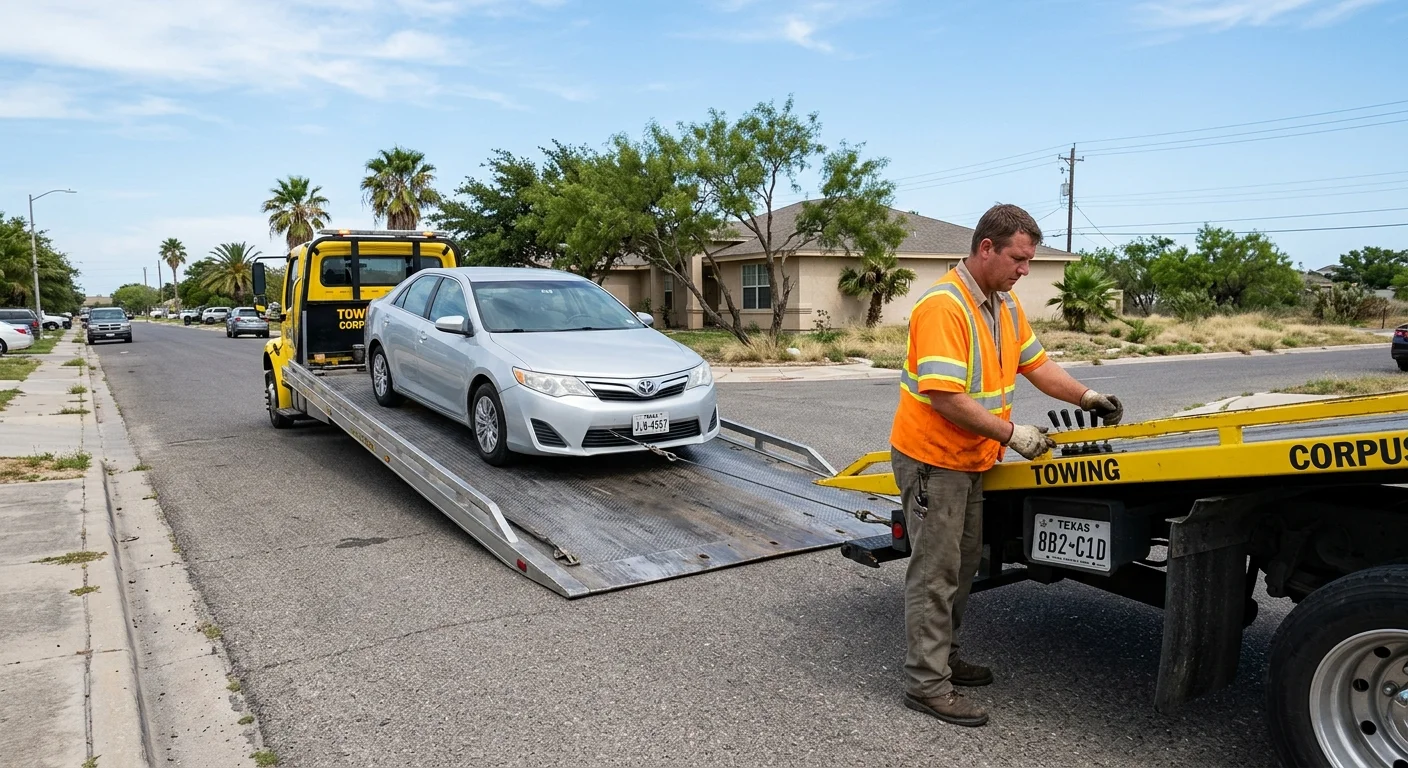
A flatbed carries the whole vehicle on a level truck deck. The operator lowers or tilts that deck, then pulls the vehicle aboard. Once loaded, all four tires remain off the road.
That’s different from an older hook-style tow. It also differs from wheel-lift towing, which usually raises one end while two tires remain on the pavement. A wheel-lift can suit many ordinary, short-distance jobs. It isn’t automatically the right equipment for every vehicle.
Keeping all four wheels aboard matters when rolling tires could create problems. That may include certain drivetrains, damaged wheels, locked steering, or very low bodywork. A flatbed also gives the operator more control over how the vehicle sits during transport. It doesn’t guarantee protection from every risk, so accurate vehicle details still matter.
The pickup location affects the loading plan too. A wide parking lot offers different working space than an I-37 shoulder. A tight downtown curb presents another setup. Tell the dispatcher about slopes, medians, gates, parking structures, and blocked wheels.
The operator makes the final equipment decision after hearing those details. If a flatbed fits the job, our flatbed towing service connects you with an independent local operator. If a wheel-lift can handle it correctly, the dispatcher can explain that option instead.
Vehicles that should only ever go on a flatbed
The owner’s manual settles this question for your specific vehicle. Check its towing or roadside assistance section when possible. Manufacturers may require a flatbed or specify another approved loading method.
All-wheel-drive vehicles deserve particular attention. Some can’t be moved with two wheels rolling because that motion may affect connected drivetrain parts. Others have manufacturer-approved procedures that depend on the model. Our guide to towing an AWD car in Corpus Christi explains what information the operator will need.
Electric and hybrid vehicles also have model-specific instructions. Battery location, tow mode, ground clearance, and designated attachment points can vary. Don’t assume every electric vehicle follows the same procedure. Give the operator its year, make, model, and current condition.
A flatbed may also be requested for these situations:
- The vehicle is lowered or has limited bumper clearance.
- One or more wheels can’t roll normally.
- Steering is locked, disconnected, or damaged.
- Collision damage has changed the vehicle’s stance.
- A classic or specialty vehicle needs full-deck transport.
- The manual specifically requires flatbed towing.
“Flatbed only” doesn’t mean every vehicle will load normally. A car with missing wheels, severe damage, or blocked access may need extra recovery equipment. Don’t hide those details because you’re worried about the quote. The operator needs them before choosing a truck and loading approach.
If you can’t reach the manual, tell the dispatcher that too. Don’t guess about neutral, tow mode, or drivetrain type. A clear description helps the matched operator decide whether a standard flatbed fits the job.
Salt air, sand, and low clearance on the island
Corpus Christi flatbed calls can look very different across the Coastal Bend. A breakdown near downtown isn’t the same as a disabled car in Flour Bluff. North Padre Island, Portland, Robstown, and Kingsville also create different access and travel considerations.
On the island, start with the exact surface. Tell the dispatcher whether the vehicle is on pavement, packed sand, or loose sand. A vehicle stuck beyond firm pavement may need recovery before it can reach the flatbed deck. Our guide to a vehicle stuck in Padre Island sand covers the location details worth sharing.
Low-clearance vehicles need another layer of detail. Mention lowered suspension, splitters, side skirts, or visible underbody contact. Include any curb, ditch, ramp, or steep driveway near the vehicle. The operator can use that information when evaluating the loading angle and required equipment.
Water exposure also changes the conversation. The National Weather Service confirms that storm surge can move inland along bays, rivers, and estuaries. However, no Corpus Christi-specific vehicle corrosion timeline was confirmed in the approved research. Be cautious with anyone claiming an exact deadline for saltwater damage.
Tell the operator if water entered the cabin, engine area, or battery compartment. Don’t present a flooded vehicle as an ordinary breakdown. A flatbed can transport it, but towing equipment can’t determine whether the vehicle is mechanically fit afterward.
For roadway pickups, give the direction of travel and a nearby exit. That matters on SH 358, SH 286, I-37, and US 181. On Park Road 22, say whether you’re in Flour Bluff, near the causeway, or already on North Padre Island.
What a flatbed tow costs here
This site publishes a light-duty hookup starting at $125, including the first five miles. A flatbed starts at that same published $125 hookup. The figure can rise with vehicle size.
Published mileage guidance is roughly $3 to $5 per mile after five miles. The published after-hours surcharge is $25 to $50 between 10 PM and 6 AM. These are this site’s planning figures, not guaranteed totals or statutory rates.
The independent operator matched to your call sets the actual price. That operator should quote the price before doing the work. The driver contracts with you directly, and you pay the operator directly.
Give the dispatcher enough detail for a useful quote. Include the pickup and destination, vehicle size, drivetrain, and whether all wheels roll. Mention collision damage, sand, locked steering, missing keys, low clearance, or restricted access. A starting hookup figure shouldn’t be treated as the finished total.
Distance can change quickly across this area. A local move within Corpus Christi differs from a trip involving Portland, Robstown, or Kingsville. Use exact addresses whenever you have them. If you don’t know the address, send a map pin and identify the roadway.
Don’t confuse a requested tow with a nonconsent tow. Texas publishes maximum charges for certain nonconsent tows, but those caps don’t apply to a consent tow you request yourself. Local lower caps couldn’t be confirmed from an accessible Corpus Christi source. For current nonconsent rules, check the Texas Department of Licensing and Regulation.
How to ask for one and get one
Lead with the equipment request: “I need a flatbed tow.” Then explain why. Say whether the owner’s manual requires one, the vehicle is all-wheel drive, or the wheels can’t roll.
Next, provide an exact pickup point. A pin helps, but add the direction of travel and a landmark. On a highway, include the nearest exit. In a parking garage, report the posted clearance and your level. On Padre Island, distinguish pavement from sand.
Give the vehicle’s year, make, and model. State whether it’s front-wheel drive, rear-wheel drive, all-wheel drive, or four-wheel drive. If you’re unsure, say that instead of guessing. The operator may confirm the correct method from the vehicle information.
Describe its present condition in plain words. Can the steering turn? Do the wheels roll? Are the keys available? Is the vehicle lowered? Is a tire folded under the body? Did water enter it? Photos may help if the dispatcher or operator requests them.
Confirm the destination before loading. That could be a repair shop, residence, storage location, or another lawful drop point. Make sure someone can authorize access at the destination. Restricted gates and crowded lots should be mentioned before dispatch.
Quick Tow Corpus Christi is a referral service. We connect drivers with independent towing operators, but we don’t perform the tow or own the truck. Texas requires the operator who does the work to hold the applicable TDLR license, and that record is public. You can also check a towing operator through the TDLR license search by name, license number, city, county, or ZIP code.
When to call us
Call when the vehicle’s manual requires a flatbed, its wheels can’t roll, or its condition needs evaluation by a licensed towing operator. Call us at (361) 967-8088 and we’ll connect you with a licensed operator.