When you need flatbed towing in Portland, TX, start with the vehicle’s condition and exact position. Details about its wheels, steering, drivetrain, and surroundings help the operator plan before reaching you. They also help avoid sending equipment that doesn’t fit the vehicle or pickup area.
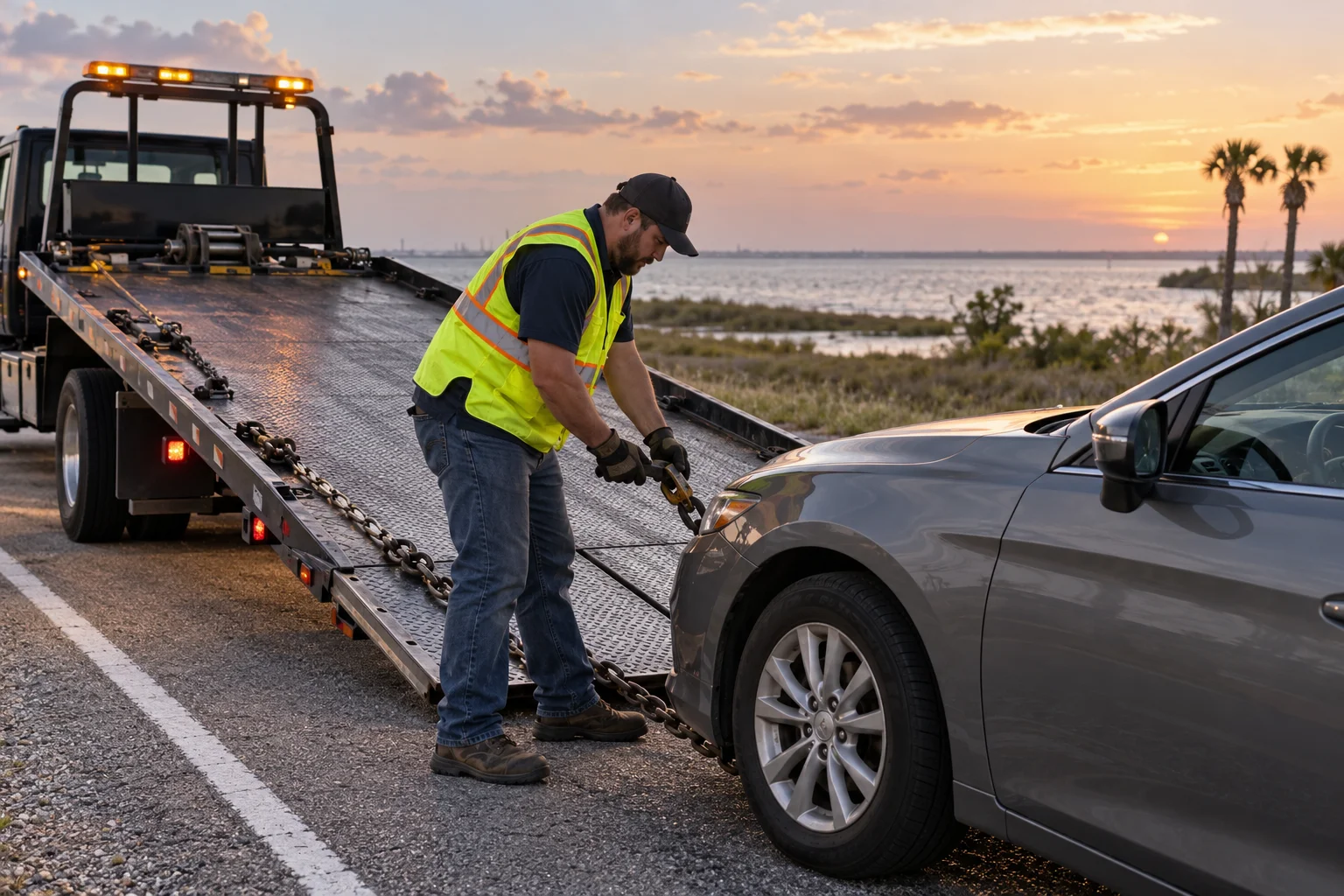
Describe why the vehicle cannot drive
Begin with what happened, not what you think failed. Tell the operator what you saw, heard, or felt before stopping. A warning light, fluid beneath the vehicle, smoke, impact damage, or a sudden loss of power gives useful context.
Say whether the engine starts and stays running. Explain whether the transmission shifts into neutral. If you tried moving the vehicle, describe what happened. Don’t keep testing it when a wheel drags, something scrapes, or fluid is leaking.
Mention any collision damage, even when it appears minor. A bent panel near a tire can limit wheel movement. A loose bumper or underbody panel can also affect clearance. The operator needs the visible condition, not a roadside diagnosis.
Give the year, make, model, and vehicle type. Include modifications that could affect loading. Examples include lowered suspension, oversized tires, a body kit, or a roof-mounted load. Tell the operator if it’s an electric vehicle, an all-wheel-drive model, or a pickup carrying cargo. The operator can then determine which equipment and loading plan fit that exact vehicle.
A flatbed isn’t automatically the right answer for every breakdown. The vehicle’s condition, manufacturer guidance, weight, clearance, and pickup area all matter. Our flatbed towing service connects Portland callers with independent operators who can review those details.
If traffic or another immediate hazard makes inspection unsafe, don’t walk around the vehicle. Share what you can see from a safe position. The operator can assess the remaining details on scene.
Share wheel, steering, and drivetrain condition
The operator needs to know whether every wheel can roll. Check only if you can do so without entering traffic or standing near moving vehicles. Tell the operator if a tire is flat, a wheel looks bent, or one corner sits lower than the others.
Explain whether the steering wheel turns normally. If the steering is locked, say so. Also mention whether the keys are available. Some vehicles need power or a specific key position to release the steering or select neutral.
Be clear about the parking brake. Say whether it releases or appears stuck. If the dashboard has lost power, mention that too. A dead battery can change how the operator accesses vehicle controls, even when the original problem involved something else.
The drivetrain description should stay simple and accurate. Tell the operator whether the vehicle is front-wheel drive, rear-wheel drive, all-wheel drive, or four-wheel drive if you know. Don’t guess. The owner’s manual or vehicle information may confirm it. If you can’t confirm the drivetrain, say that plainly and provide the model details.
Report anything hanging beneath the vehicle. A damaged suspension part, exhaust section, or underbody panel can change the available clearance. Don’t crawl underneath to inspect it.
These details don’t prescribe one loading method. The operator matched to the request must choose an approach after considering the vehicle and scene. That’s especially important when wheels won’t turn, the transmission won’t enter neutral, or accident damage limits movement.
For a broader look at vehicle-specific planning, see our Corpus Christi flatbed towing guide. It explains why the operator needs more than the words “send a flatbed.”
Explain your position near US 181 or the bridge approaches
“Portland near US 181” isn’t precise enough for a pickup. Tell the operator which direction you were traveling and whether you’re on the Portland side of the Harbor Bridge approach. Say whether you’re heading toward Corpus Christi, Portland, or farther along the US 181 corridor.
Share a map pin when possible. Then read the location back in plain words. Include the road name, direction of travel, nearest visible exit or cross street, and a nearby sign or business. A dropped pin can land across a divided roadway or on the wrong side of an access road.
Describe where the vehicle stopped. It may be on a shoulder, in a travel lane, beside an entrance, or inside a parking lot. Say how much room appears available around it. Don’t estimate measurements. Photos can give the operator better context when they’re safe to take.
Bridge approaches require especially clear directions. “Before the bridge” changes meaning with your direction of travel. State whether you’re north or south of the bridge and which way the vehicle faces. Mention whether barriers, traffic, or a narrow shoulder limit access.
For a breakdown farther north, our US 181 breakdown guide from Portland toward Sinton explains which location details help distinguish one part of the corridor from another.
If the vehicle is exposed to traffic, say that first. Quick Tow takes calls around the clock and refers drivers to independent, licensed and insured operators. We don’t own tow trucks or perform the towing work.
When access or clearance changes the loading plan
A flatbed tow truck in Portland, Texas, still needs workable access to the vehicle. Tell the operator about gates, tight turns, low structures, steep driveways, soft ground, or parked vehicles blocking a direct approach.
Parking garages need extra detail. Share any posted height limit and the level where the vehicle sits. Don’t assume a flatbed can enter. The matched operator may need a different truck or a separate plan to move the vehicle into an accessible loading area.
For apartment lots and shopping areas, describe the nearest open entrance. Mention medians, curbs, islands, loading zones, and one-way lanes. If a gate requires a code or resident access, arrange that before the operator reaches the property.
Clearance around the disabled vehicle matters too. Tell the operator if its nose faces a wall, another car sits close behind it, or both sides are blocked. Say whether the vehicle is parked straight, angled, or partly over a curb. Photos from the front, rear, and open side can help if they’re safe to capture.
Report ground conditions without guessing about recovery needs. Say whether the tires are on pavement, gravel, grass, sand, or mud. If the vehicle left the roadway or became lodged, it may need recovery work rather than a standard tow. Don’t describe it as an easy pull.
Never tell an operator how to rig or load the vehicle. Clearance, damage, weight, and wheel condition all affect that decision. A careful request describes the scene and leaves the method to the licensed operator handling it.
For urgent situations where the scene is changing or the vehicle is creating a traffic concern, use the emergency towing referral service.
Confirm the equipment, destination, and quote
Before ending the call, confirm that the operator knows you’re requesting a flatbed assessment. Repeat the vehicle year, make, model, drivetrain if known, and visible damage. Ask whether the planned equipment fits the information you provided.
Next, give the complete destination. A shop name alone can create confusion when locations have similar names. Share the street address and city. Confirm that the destination expects the vehicle, especially after normal business hours. Ask where the vehicle should be left if the property has more than one entrance or service area.
Tell the operator whether you’ll travel separately. Don’t assume passenger transportation is available. Remove medicine, identification, house keys, electronics, and anything else you may need before the vehicle leaves. If you can’t access the cabin, tell the operator.
Ask the matched operator for the total quoted price before work begins. Quick Tow is a referral service and doesn’t set operator prices. The driver contracts with and pays the independent towing operator directly.
The quote may depend on information such as pickup conditions, vehicle size, destination, distance, and extra recovery work. That’s why accurate details matter. If the operator reaches the scene and finds a locked wheel, hidden damage, blocked access, or a different destination, ask how that changes the quote before authorizing additional work.
Finally, confirm the payment methods the operator accepts. Get the towing company’s name and keep any receipt or paperwork provided. Texas requires towing companies operating tow trucks over public roadways to be licensed. You can check an operator through the TDLR license search.
When to call us
Call when a disabled or damaged vehicle in Portland needs assessment by a licensed towing operator, especially near US 181 or the bridge approaches. Call us at (361) 967-8088 and we’ll connect you with a licensed operator.