The keys are gone, and the car has not moved in months. That is the usual junk car removal without keys call in Corpus Christi, from a locked sedan in a Flour Bluff carport to a dead pickup on a Robstown lot. Missing keys are an equipment problem. They are not permission to haul a car you do not control, and they do not mean every wreck comes off the same way.
Who owns and controls the vehicle
A licensed operator can only move a car that someone with the right to send it has asked them to move. If the title is in your name and the car sits on your driveway off Ayers, behind a Calallen house, or on a Kingsville caliche pad, this is a consent job. You call. You authorize the pickup. The independent operator you are matched with does the hook.
If the car belongs to a tenant, an ex, or nobody you can name, stop. That is not the same job. An abandoned car on a rental property follows a different path than a car you own. Private property towing in Texas is a nonconsent category with its own rules. This page is not that process, and this site will not invent notice periods, landlord shortcuts, or city forms that were not confirmed from primary Texas sources.
Ownership is the gate. Keys are not. A locked steering column does not prove the car is yours. A spare key in a junk drawer does not replace paperwork if the operator asks for it. Lienholders, stolen-vehicle hits, and title brands are for you and the title records. They are not for a blog to guess. If you cannot show you control the vehicle, a careful operator will walk away, no matter how badly you want the space back.
Quick Tow Corpus Christi connects you with independent, licensed operators. We do not take the car. We do not hold a towing license. Texas requires towing operators who work over public roadways to hold the right license for the work, through the Texas Department of Licensing and Regulation. The three operator license types are incident management, private property, and consent. A junk pickup you request is consent work. You can verify the person who shows up on TDLR’s license search. Search by tow truck operators, name, city, county, or zip.
Corpus Christi proper, Portland across the Harbor Bridge, Flour Bluff, Padre Island, Robstown, and Kingsville all see the same split. The roads change the drive. They do not change who is allowed to send the car. If you own it, say so in the first minute of the call. If you do not, say that too. Mixing those stories is how a simple yard cleanup turns into a refused hook.
Whether the wheels roll and steer
Tell the operator whether the car rolls and whether the steering turns. On a junk vehicle pickup in Corpus Christi, that matters more than whether the engine will fire.
Keys usually do three mechanical things. They unlock the column, they let the shifter move, and they release the parking brake. Without them, a job to tow a junk car with no keys depends on equipment, not on starting the motor. Plenty of these cars are already dead. The operator is not trying to drive it to a yard. They are trying to get it onto a truck without tearing up the pavement, the fence, or the car beside it.
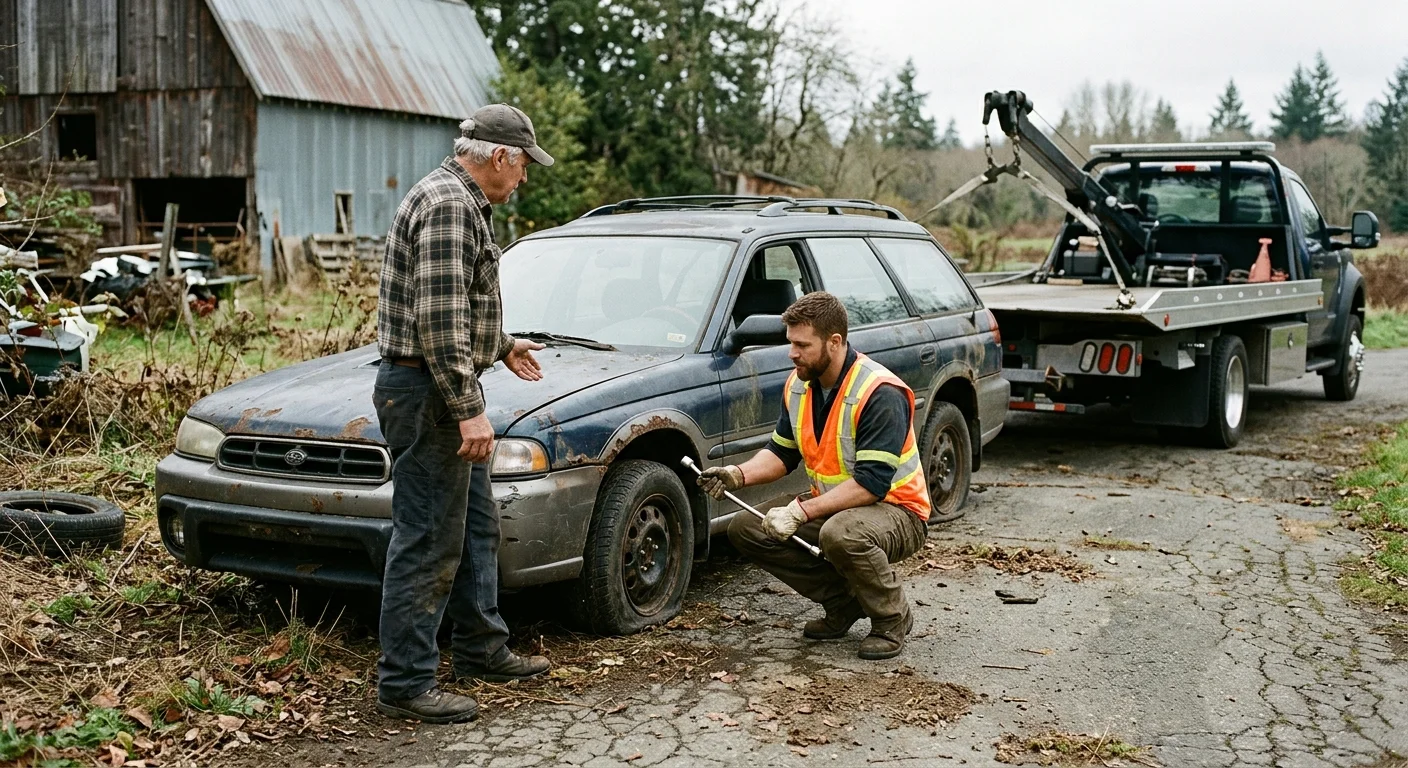
If the wheels roll and the steering is free, a wheel-lift or a short pull onto a flatbed can be enough. If the column is locked at a hard angle, or the transmission will not go to neutral, the operator may need a flatbed, dollies, or a winch. Frozen brakes from sitting in salt air on Padre Island or in Flour Bluff are a different problem than a car that rolled last week on a Robstown side street. Say that on the call. A push-button car with a dead module is not the same as an old column-shift sedan. Name the year and how it starts, even if it does not start at all.
Nobody should promise every attempt to remove a non-running car looks the same. A lowered car on blocks, a truck with a seized parking brake, or a van wedged between a boat trailer and a carport post all change the rigging. The operator on scene picks the method. You decide whether you accept the quote before they start. Do not break the steering lock yourself. Do not cut a cable to “help.” That is how a simple load becomes a damaged hub and an argument about who pays.
Will a junkyard take a car without a key? Some will. Some want a key if they plan to roll it around a yard. That is the yard’s intake rule, not a TDLR towing-license rule this page can cite. Tell the operator the keys are gone before they leave the shop so they bring the right truck. If you want the longer local picture on hauling wrecks, read our guide to junk car removal in Corpus Christi. The junk car and abandoned vehicle removal page is the service path when you are ready to match with an operator.
Access around the vehicle
Access is the third question, after ownership and roll. A wreck on a wide Kingsville drive is not the same as a compact parked nose-in under a low carport off Ocean Drive.
Describe what sits around the car. Fences, dogs, boats, a second vehicle, a low roof, a soft lawn after a Gulf rain. Operators need room for the truck and for the path the car will travel. On Padre Island and in Flour Bluff, sand and shell can swallow a drive tire. Inland in Robstown, Bishop, or west of the city, mud after a downpour does the same thing. Say if the car is up on stands, missing wheels, or sitting in grass that has grown through the frame. Say if catalytic converters, batteries, or wheels are already gone. Sitting cars get stripped. The operator needs to know what is still attached before they quote a load.
Apartment lots near SPID and tight streets in older Corpus neighborhoods often mean the wrecker cannot line up straight. The operator may need to winch from the street. That only works if you have the right to occupy that space and the car can be pulled without hitting a neighbor’s bumper. Do not drag it yourself with a pickup and a strap. That is how bumpers come off and how people get hurt.
If the car is blocking a shared drive, say so. That still does not turn an ownership problem into an equipment problem. Access explains how the truck works. It does not replace the person who has to authorize the removal. Portland and the Northside add the Harbor Bridge run. That does not change the hook. It can change how long the operator is on the road once the car is on the bed. Mileage past the first five miles is billed on top of the hookup.
Clear what you can before anyone arrives. Kids’ toys, trash cans, a boat tongue in the path. Leave the car where it sits if moving it would mean rolling a locked column down a slope. The operator would rather see the true problem than a car you already wedged into a worse corner.
Documents the operator requests
Bring what you have, and do not invent the rest. Operators commonly ask for photo ID and proof you have the right to send the vehicle. A title is the cleanest proof. Registration, insurance in your name, or a bill of sale may or may not be enough. That call belongs to the operator and to Texas title rules, not to a blog.
Searchers ask whether a junkyard will take a vehicle without a title. A Texas-specific yes or no is not confirmed from the primary sources this page is allowed to use. Do not treat a California pink slip, a derelict certificate from another state, or a “$3,000 rule” as local law. No $3,000 towing or junk-removal threshold is verified here. If you need a replacement title, use the Texas Department of Motor Vehicles. Confirm what a dismantler will accept before you schedule the truck.
If the car is already in a vehicle storage facility, that is a retrieval, not a driveway junk pickup. TDLR’s consumer information says owners retrieving a stored vehicle must show photo ID, proof of ownership, and payment of towing and storage fees. Proof of ownership can include a driver’s license that matches registration, an insurance card, the title, a tax collector’s receipt, a lease or rental agreement, or TDLR forms. Access to papers and personal items in a stored vehicle is free. Those rules apply to storage lots. They do not automatically write the intake policy of a scrap yard on the other side of town.
Take your plates, garage door remotes, and anything you still want out of the cabin before the hook. Once the car leaves, getting back in is no longer a driveway errand. You do not need to pay a storage lot to grab documents during their access window. You do need to be honest on a consent junk call. If you cannot produce ID and some ownership trail, expect the operator to decline.
Licensing is separate from title. Texas towing companies that control or operate tow trucks over public roadways must be licensed, with exemptions set out in Occupations Code Chapter 2308. Municipalities can add local registration for nonconsent work. A junk pickup you request is still consent work. Check the person who shows up. Do not assume the brand on this site is the licensee. It is not. TDLR’s towing page is the place to read the license types in the state’s own words.
Confirm the removal plan and payment
Before anything is hooked, get the plan in plain words. How they will take a non-running car with no keys. Flatbed, wheel-lift, dollies, winch. Where the car is going. What you will pay the operator, not a number you saw in an ad from another city.
Our published light-duty hookup starts at $125 and covers the first five miles. A flatbed starts at that same $125 hookup and prices up with vehicle size. Extra distance is roughly $3 to $5 a mile after those first five. After-hours work between 10 p.m. and 6 a.m. carries a published $25 to $50 surcharge. Those are this site’s published figures. They are not a state cap, and they are not a promise of the operator’s final bill. The operator matched to your call quotes the price before doing the work.
A tow you request yourself is not the TDLR nonconsent cap. Those caps, including $272 for vehicles 10,000 pounds or less, apply to tows without the owner’s consent. Do not mix the two. Drop fees, storage-by-the-day, and tow hearings belong to nonconsent and storage-lot fights. They are the wrong map for a car you are asking someone to haul off your own property.
Payment is between you and the operator. Have a way to pay on site. Confirm whether they want personal gear out of the cabin and the license plates off. Plate return and title transfer after a sale are TxDMV matters. This page will not recite an unverified checklist as if it were statute.
If the quote depends on the wheels rolling, say so while you are still on the phone. A locked column in a Padre Island driveway and a free-rolling sedan on Saratoga Boulevard are not the same ticket. Agree on the method, the destination, and the number. Then stay on site so you can sign whatever authorization the operator requires. If they get there and the story has changed, missing keys, missing title, a car that will not roll, they can decline the load. That is the right outcome. It is better than a truck leaving with a car nobody had the right to send.
When to call us
Call when you own the car, the keys are gone, and you need a licensed operator to check the roll, the access, and the paperwork before anyone hooks it. Tight carports, sand, and seized brakes are reasons to match with someone who has the right truck, not reasons to yank the car yourself. Call us at (361) 967-8088 and we’ll connect you with a licensed operator.