Your car has stopped, and you need a tow. Before calling, gather five details: your exact location, vehicle information, wheel condition, destination, and the operator’s quote. Clear answers help us match your request with an independent towing operator serving your part of the Coastal Bend.
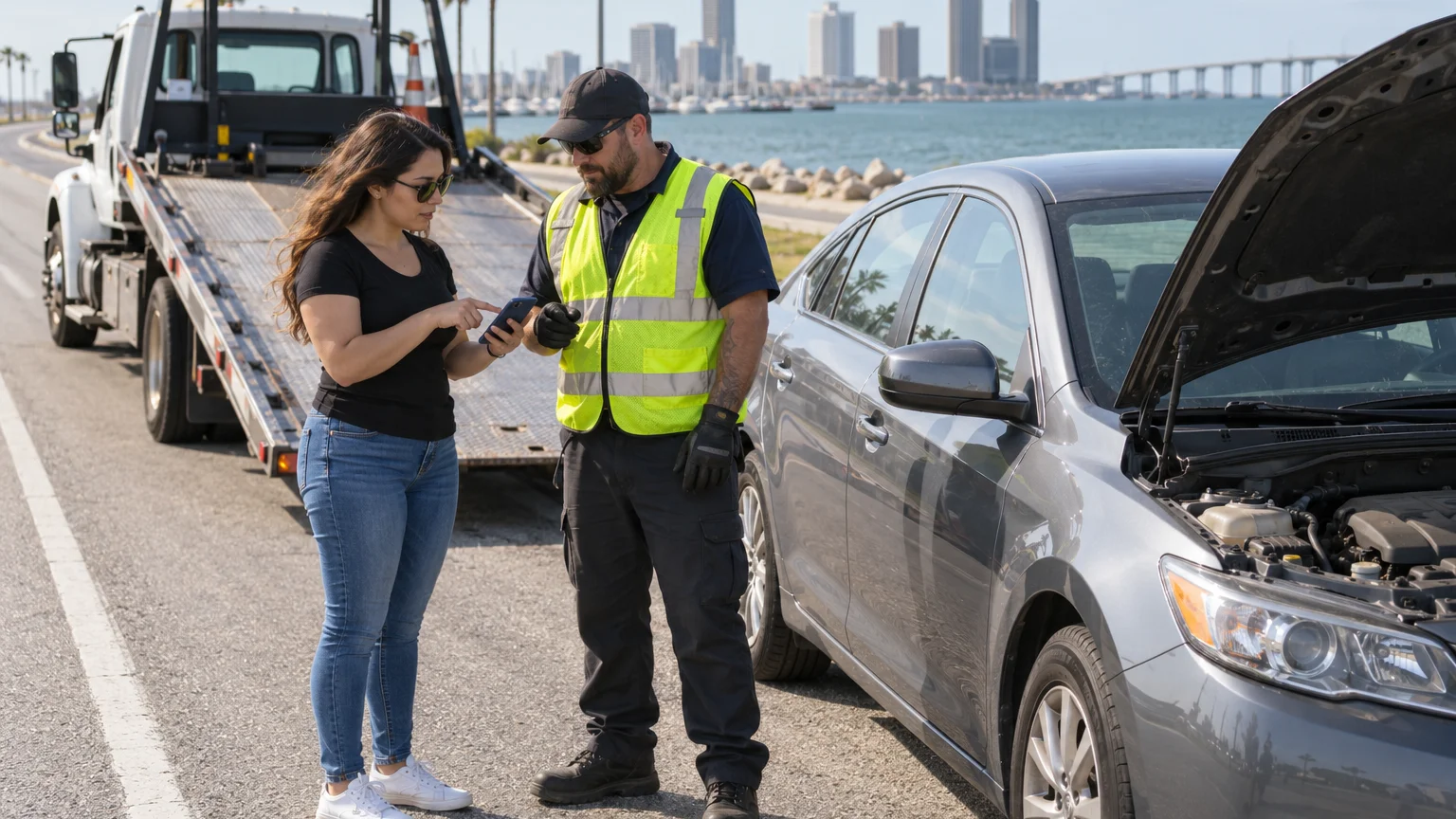
Share your exact location and road position
Start with more than a city name or location pin. Tell us the road, direction of travel, nearest intersection, and where the vehicle sits. A tow request on a shoulder differs from one inside a parking garage.
Your phone’s map pin helps, but add visible landmarks. Street signs, businesses, bridge approaches, exit signs, and mile markers can narrow the pickup point. If the pin appears across the road, say which side you’re actually on.
Corpus Christi requests need specific local context. These descriptions give an operator something useful:
- “Southbound on Crosstown Expressway, past the last exit.”
- “On SPID in Flour Bluff, on the right shoulder.”
- “Near the Corpus Christi side of the JFK Causeway.”
- “On Padre Island, inside a beach access area.”
- “Northbound on US 181 near Portland.”
- “On US 77 between Robstown and Kingsville.”
For a parking lot, provide the business name and nearest entrance. Include the garage level if you’re under a building. Tell us about a gate, low ceiling, narrow lane, loose sand, ditch, or blocked access. Don’t assume a map pin shows those details.
Also explain the vehicle’s road position. Is it fully inside a parking space, partly in a traffic lane, against a curb, or beyond the paved shoulder? If it left the pavement, describe the surface and how far it moved.
If you’re still trying to locate nearby help, our guide to finding a tow truck near you in Corpus Christi explains what location details matter.
Describe the vehicle and what stopped working
Next, identify the vehicle. Give the year, make, model, color, and body style. “White Ford” isn’t enough. A white Ford sedan, Transit van, and full-size pickup present different matching needs.
Mention anything that changes the vehicle’s size or clearance. That includes a lowered suspension, oversized tires, roof cargo, utility body, camper shell, loaded bed, or attached trailer. If it’s a pickup, say whether it’s a standard pickup or dually. For an electric vehicle, provide the exact model.
Then describe what happened in plain language. You don’t need to diagnose the failure. Tell the operator what you saw, heard, or felt:
- The engine shut off and won’t restart.
- The vehicle starts but won’t move.
- A tire is flat or separated from the wheel.
- Fluid is visible under the vehicle.
- The vehicle overheated.
- The key is missing or locked inside.
- The vehicle was involved in a collision.
- The vehicle is stuck in sand, mud, or a ditch.
Those details help separate a towing request from a roadside service request. A dead battery, empty fuel tank, lockout, or usable spare tire may call for roadside assistance. A disabled vehicle that can’t continue may need an emergency towing referral.
Roadside coverage sometimes includes towing, but plans differ. Check your insurer, vehicle warranty, membership, or credit card benefits directly. Confirm any destination limit, reimbursement process, and authorization requirement before relying on that coverage.
There’s no verified universal “80% rule” in the approved Texas towing sources for requesting an emergency car tow. Don’t use that phrase as a substitute for vehicle details. Give the operator the actual vehicle, load, trailer, and condition instead.
Report wheel, steering, and drivetrain condition
A vehicle’s wheels and steering tell the operator how it may be loaded. Before you call for a tow, report what still moves and what doesn’t. Don’t force the shifter, steering, or damaged wheels just to test them.
Say whether the transmission can shift into neutral. If it can’t, tell the operator. Mention whether the keys are present and whether the engine starts. Electronic parking brakes, dead batteries, and collision damage may affect what controls still respond.
Check the wheels from a position where you can observe them without moving the vehicle. Report these conditions:
- One or more wheels won’t roll.
- A wheel points at an unusual angle.
- A tire has come off its rim.
- The steering wheel is locked.
- The parking brake won’t release.
- A wheel or axle appears damaged.
- The front or rear of the vehicle is against a curb.
- Debris blocks access to either end.
Tell the operator whether the vehicle is front-wheel drive, rear-wheel drive, all-wheel drive, or four-wheel drive, if you know. If you don’t know, say so. The exact year, make, and model lets the matched operator check the vehicle instead of working from a guess.
Describe collision damage without diagnosing it. “The front-left wheel won’t turn” is more useful than “the suspension is ruined.” Also mention loose body panels, broken glass, leaking fluid, or deployed airbags.
Don’t request a specific towing method solely from an online rule. The operator needs the full vehicle condition and pickup setting. A garage in Corpus Christi proper, a paved shoulder near Portland, and loose sand on Padre Island can require different planning even when the vehicle model matches.
Choose a confirmed destination before dispatch
Have a destination ready before the operator heads toward you. Provide its full address, not only the shop name. Corpus Christi has businesses with similar names, multiple locations, and entrances on different streets.
Call the destination yourself when possible. Confirm that it’s the correct location and that it can receive the vehicle. Ask where a disabled vehicle should be left and whether anyone must authorize the drop. If the business is closed, don’t assume its parking lot or service lane accepts unattended vehicles.
Your destination might be:
- A repair shop that has agreed to inspect the vehicle.
- A dealership that confirmed where to leave it.
- Your home or another private property.
- A tire shop for wheel or tire damage.
- A body shop handling collision damage.
Distance matters across the Coastal Bend. A pickup in Flour Bluff going into Corpus Christi follows a different path than one continuing toward Padre Island. A vehicle near Portland may be going north rather than back into Corpus Christi. Inland calls near Robstown or Kingsville can involve another town entirely.
Share the final address before accepting the match. Changing the destination after dispatch can change the route, mileage, or operator assigned to the request. Ask the operator directly how a destination change would affect the quoted charge.
If your preferred shop is closed, review these after-hours towing destination options before choosing a drop point. Keep the shop’s instructions, gate information, and key-drop directions available for the matched operator.
A free tow couldn’t be confirmed as a general option. Your insurer, roadside plan, warranty, dealership, or repair shop may offer benefits, but only that provider can confirm the terms.
Confirm the matched operator and quote
Quick Tow Corpus Christi is a referral service. We connect drivers with independent towing operators. We don’t own trucks, employ tow drivers, perform tows, or set the operator’s price. You contract with and pay the matched operator directly.
Before work begins, confirm the operator’s name and towing company. Every operator in the network is licensed and insured. Texas requires towing companies operating tow trucks on public roadways to hold the applicable license.
You can check an operator through the Texas Department of Licensing and Regulation license search. Select “Tow Truck Operators,” then search by the operator’s name, license number, city, county, or ZIP code.
Ask the matched operator to quote the job before work starts. Confirm what the quote covers, including pickup, destination, mileage, vehicle condition, and any access issue you reported. Ask what could cause the charge to change. Keep in mind that the operator, not Quick Tow, sets and collects the final amount.
A tow you request yourself is a consent tow. Texas maximum charges for nonconsent towing are a separate subject and shouldn’t be treated as the price for a tow you order. If the vehicle was removed without your permission, the rules and dispute process differ.
Before confirming, repeat the core information:
- Exact pickup point and road position.
- Vehicle year, make, model, and condition.
- Whether the wheels roll and steering works.
- Whether the transmission shifts into neutral.
- Confirmed destination address.
- Operator’s name, company, and quoted charge.
Save the operator’s details and any written quote you receive. If the arriving company doesn’t match the company you confirmed, pause and verify the match before authorizing work.
When to call us
Call when your vehicle can’t continue and the job needs a licensed towing operator. The line takes calls 24/7, and we’ll use your location, vehicle condition, and destination to seek an appropriate referral. Call us at (361) 967-8088 and we’ll connect you with a licensed operator.