For RV towing in Aransas Pass, TX, first identify what stopped moving. A motorhome breakdown and a disabled travel trailer require different equipment. The right choice may be roadside help, towing, or separate help for two vehicles.
Motorhome or travel trailer: what broke down
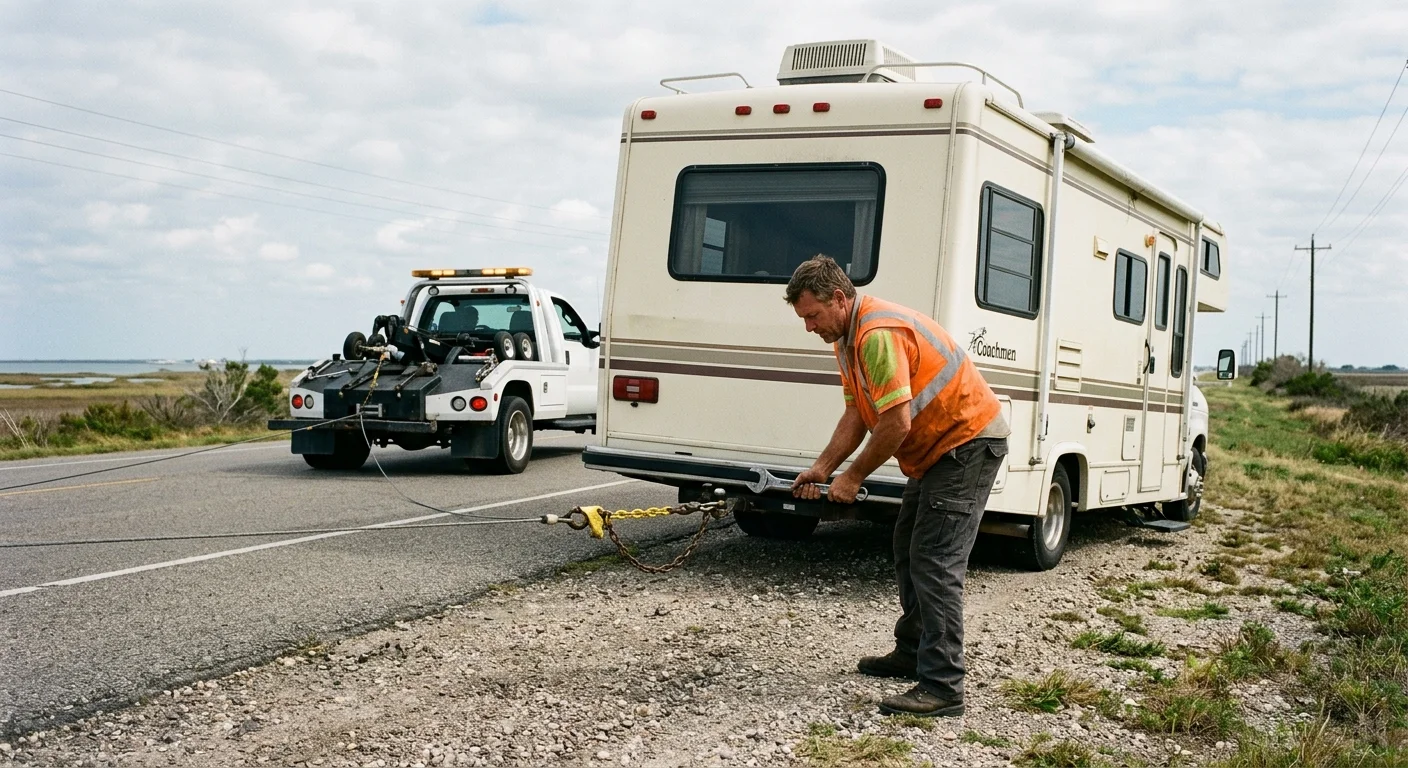
A motorhome combines the living space and powered vehicle. If its engine, transmission, steering, or wheels stop working, the entire RV may need transport. The matched operator needs to know the motorhome’s class, length, height, weight information, and current condition.
A travel trailer creates a different problem. It has no engine, so the trouble may involve the tow vehicle, hitch, trailer wheels, or running gear. A disabled pickup doesn’t always mean the trailer itself is damaged. The call may require help for the pickup, a separate way to move the trailer, or both.
Start by describing the failure in plain language. Say whether the engine starts, the transmission shifts, and the steering responds. For a trailer, explain whether it remains connected to the tow vehicle. Mention any visibly damaged tire, wheel, axle, coupler, safety chain, jack, or hitch component.
Don’t label the problem as “just a flat” unless you’ve checked every wheel. A trailer can have more than one affected tire. A damaged wheel or axle also changes the equipment request.
Our general RV and trailer towing guide explains how these calls differ from ordinary car tows. The longer Corpus Christi RV towing article covers planning across the wider metro. An Aransas Pass call still begins with the exact RV type and its present condition.
If you’re pulling a boat instead of an RV, use the boat trailer towing guide. Boat trailers create their own loading, clearance, and destination questions.
Roadside help or towing near Aransas Pass
Roadside help fits problems that an equipped operator can address where the RV sits. Examples may include a battery issue, lockout, fuel request, or serviceable tire problem. The available service depends on the RV, its location, and the equipment required.
A tow becomes the more likely request when the RV can’t be made movable at the scene. That includes a motorhome that won’t run and a trailer with damaged rolling or hitch components. Recovery equipment may also be needed when the unit isn’t positioned for a normal hookup.
The shoulder, parking area, campsite, and fuel station each present different access conditions. Tell the referral service whether the RV is fully outside traffic. Mention nearby barriers, soft ground, a narrow entrance, or parked vehicles. Those details help identify an operator who can evaluate the job.
Use roadside assistance when the problem appears limited and the RV remains stable. Still provide its full dimensions. Equipment that works for a passenger car may not fit a motorhome or trailer.
Don’t assume every operator handles every RV. Some calls require equipment suited to a specific length, weight, axle layout, or clearance. Quick Tow refers callers to independent operators. The operator decides whether their equipment fits the requested job.
Send clear photos if the operator requests them. Useful views include the entire roadside position, front and rear ends, wheels, hitch, and visible damage. A photo can also show whether slide-outs, steps, jacks, or accessories remain extended.
How vehicle length and hitch condition affect the request
Exact dimensions matter because “RV” covers many vehicle shapes. Give the overall length from the frontmost point to the rear edge. Include anything mounted outside the body, such as a rear rack or spare tire.
Provide the height shown in your RV records when available. Mention rooftop air conditioners, antennas, or other fixed equipment. Don’t guess if you’re uncertain. Tell the operator which figure came from the manufacturer label, registration, owner’s manual, or your own measurement.
Weight information also helps the operator evaluate the request. Look for the manufacturer label or documents showing the relevant ratings. Read the labels exactly rather than estimating from the RV’s appearance.
For a travel trailer, describe the hitch before discussing the destination. State whether the coupler is connected, separated, bent, or resting on the jack. Mention damaged safety chains, wiring, breakaway components, or weight-distribution hardware. If parts are touching the pavement, say which parts and where.
Also report the number of axles and every affected wheel. Tell the operator whether a spare is present, accessible, and intended for that trailer. Don’t promise that a roadside tire service can complete the job until the operator reviews those details.
A fifth wheel needs a different description than a bumper-pull trailer. Name the hitch type and the tow vehicle. If the pickup is disabled, explain whether the trailer remains connected in the bed.
For motorhomes, identify the class if known. Then report the wheel position, visible body clearance, and whether any leveling equipment is down. These details help prevent a mismatched referral.
Trips between Aransas Pass, Ingleside, and Corpus Christi
Location matters as much as the mechanical problem. Aransas Pass sits within a road network connecting Ingleside, Gregory, Portland, Port Aransas, and Corpus Christi. A useful dispatch description names the road, direction of travel, and nearest visible cross street or business.
State whether you’re on or near State Highway 361, State Highway 35, or a local street. If you were traveling toward Ingleside, Gregory, Portland, or Corpus Christi, name that destination. Direction matters when an RV occupies a hard-to-reach driveway or roadside position.
Trips toward Corpus Christi may involve more than a short move within Aransas Pass. Tell the operator where the RV should go before dispatch. A repair facility, storage location, campground, or private property can have different entrance and unloading conditions.
If the RV is near the Port Aransas ferry approach, say which side of the crossing you’re on. “Near the ferry” isn’t precise enough. Share a map pin and a nearby sign or cross street when possible.
Also confirm that the destination accepts the RV. Ask whether there’s room for its full length and whether access is available when needed. Quick Tow doesn’t control a destination’s rules, gate access, or receiving schedule.
An Ingleside destination may be closer than one in Corpus Christi, but distance alone doesn’t settle the choice. The RV may need a facility willing to receive its exact type. Decide where it’s going with the operator before movement begins.
Avoid changing the destination after equipment has been assigned. If plans change, tell the operator immediately. The route, required equipment, and quoted charge may also need review.
What to confirm before dispatch
Begin with your exact location. Provide a map pin, road name, direction of travel, and nearby landmark. If you’re inside a park, campground, marina, or private lot, include the entrance instructions and space number.
Next, identify every unit involved. Give the motorhome class or trailer type, overall dimensions, axle count, and available weight information. Name the tow vehicle and explain whether it can move independently.
Describe the breakdown without diagnosing beyond what you can see. Report warning lights, leaks, unusual wheel position, damaged tires, hitch condition, and whether parts are touching the ground. Tell the operator if the RV has extended slides, steps, awnings, or leveling jacks.
Confirm the requested destination and its access conditions. The operator needs to know about gates, low entrances, narrow turns, soft surfaces, and limited unloading space. If you haven’t confirmed acceptance, say so plainly.
Ask the matched operator to confirm that their equipment fits the RV’s dimensions and condition. Also ask what work is included. The operator should quote the price before doing the work, but Quick Tow doesn’t set or collect that charge.
Texas requires the operator who does the work to hold the applicable TDLR license, and that record is public. You can also check a tow operator through the Texas Department of Licensing and Regulation license search. Select the tow truck operator license type, then search using the available operator details.
Keep your phone available after making the request. If the RV’s position, condition, or destination changes, pass that information along. Accurate details give the matched operator a fair picture of the job before dispatch.
When to call us
Call when an Aransas Pass RV breakdown needs more than ordinary passenger-car equipment, or when roadside help may not solve the problem. Quick Tow will match you with an independent, licensed towing operator suited to the reported request. Call us at (361) 967-8088 and we’ll connect you with a licensed operator.