The shifter is stuck in Park on a SPID frontage road, and Neutral will not catch no matter how hard you press the brake. You can still tow a car that won’t shift into neutral. A licensed operator can load it if they know which wheels roll, how the car is driven, and whether the parking brake is still on.
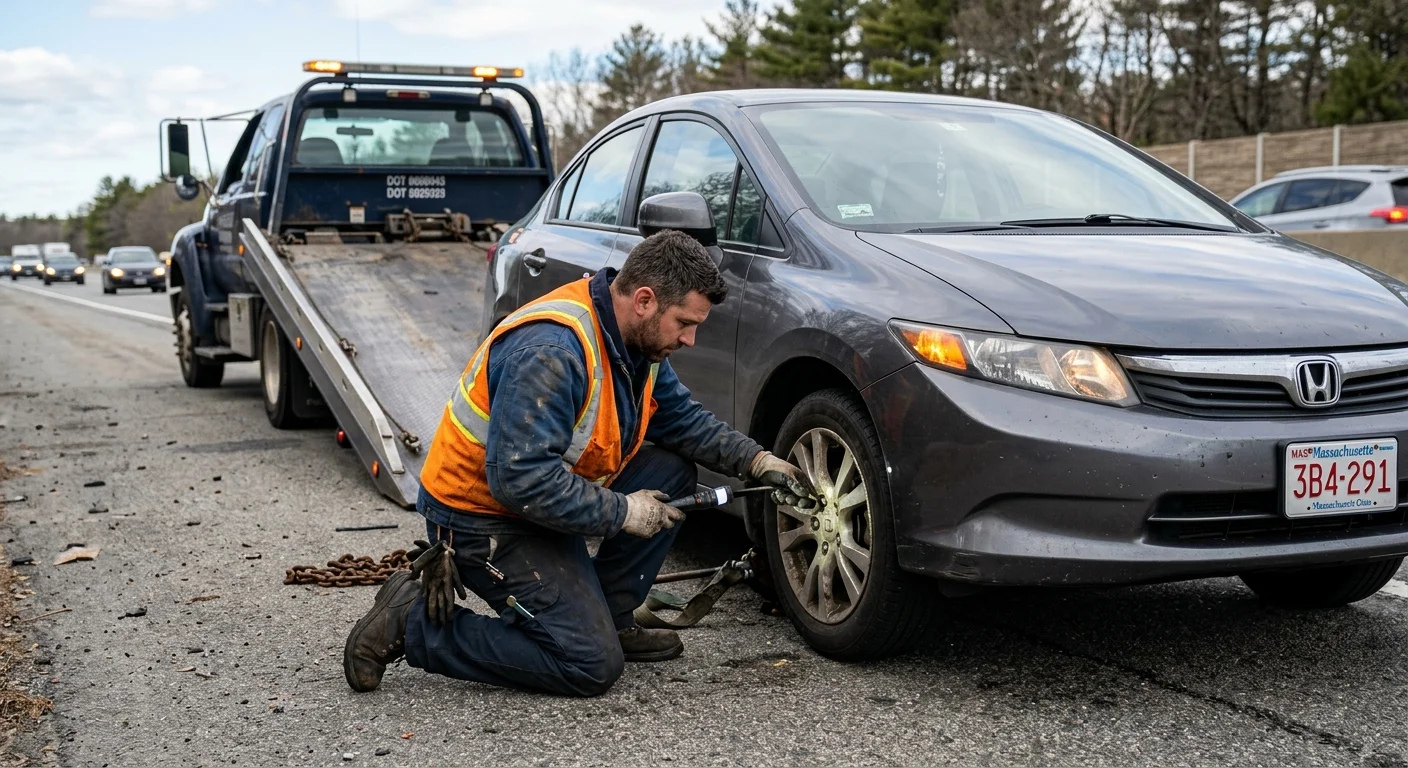
Tell the operator which wheels can move
When you call, lead with the wheels, not a guess at the transmission. If you are out of traffic, walk around the car. Try a gentle rock with your foot off the brake. Note which end moves and which end stays planted. If you cannot check safely, say so. A partial report is better than stepping into a live lane.
A car stuck in Park is not always a car with four locked tires. On many automatics, Park holds the driveline, so the driven wheels may refuse to roll while the other pair still turns. A front-wheel-drive sedan on Leopard Street can sit with locked fronts and free rears. A rear-drive pickup on SH 44 toward Robstown can do the reverse. If you push and nothing moves, say all four feel locked. That single fact changes the loading plan more than the shifter position.
If you are on the I-37 shoulder, the Harbor Bridge approach, or the Park Road 22 causeway, stay with the vehicle and keep hazards on. Do not cross live lanes to inspect the far side. Other drivers must move over or slow for a permitted tow truck using proper lights under Texas Transportation Code § 545.157. You still treat every Coastal Bend shoulder as live traffic.
Give dispatch the basics in one pass: year, make, and model if you know them. Automatic or manual. Which wheels, if any, rotate. Whether the car sits level, in sand, against a curb, or nose-down in a ditch off Waldron Road in Flour Bluff. That is enough for the operator we match you with to choose wheel-lift towing or a flatbed before they leave the yard. A wheel-lift needs a pair of wheels that can be supported without dragging a locked tire. A bed can carry the whole car. Guessing on the phone can match you with the wrong truck from Portland when the car in Calallen will not roll onto a lift.
Share the drivetrain and parking brake condition
The drivetrain tells the operator which wheels must not spin on the pavement. Front-wheel drive, rear-wheel drive, four-wheel drive, and all-wheel drive are not interchangeable for a tow. If you are not sure, read the badge on the tailgate or the owner’s manual. For all-wheel drive, say “AWD” on the call and skim our guide on how to tow an AWD car in Corpus Christi. Do not assume Neutral will free every axle. Many AWD systems can still turn internal parts when two wheels roll on the road. The manufacturer’s towing section, not a generic rule, decides whether those wheels may touch the pavement.
Parking brake condition is the other half. A mechanical pedal or handle may still be set from when you parked. An electronic parking brake can stay clamped after a dead battery, even if the dash button does nothing. Neutral with the parking brake on is still a car that will not roll. Dragging those tires on asphalt along Airline Road or through a packed lot on Staples is how you add flat spots and scuffed wheels to a simple no-start.
Say what you already tried. Ignition on or dead. Brake lights working or dark. Cluster showing Park, a blank screen, or a warning. If the manual names a shift-lock release, you can mention that you looked and could not use it. Do not take the console apart on the shoulder. The operator does not need a full diagnosis. They need to know the car may not roll, and that the parking brake may still be holding a pair of wheels.
Manual transmissions stuck in gear are a different feel. The clutch does not free the wheels if a gear is still engaged. Say “manual, stuck in gear” rather than “it will not go to Neutral.” That phrasing keeps the operator from planning around an automatic parking pawl that is not there.
If the car sat in salt air on Padre Island or along Ocean Drive, mention a brake that may have seized after high water. Do not invent a rust timeline. Describe what you see: a frozen drum, a caliper that will not release, a wheel that will not turn by hand. The operator on scene decides how to support that corner. You are not asking them to repair it. You are asking them to load it without grinding a locked tire down the block.
Don’t force the shifter or drag locked wheels
Do not muscle the shifter. On many automatics, a shift interlock keeps Park selected until the brake switch and the electrical system agree. A dead battery can leave that lock engaged even though the transmission itself is fine. Pulling harder does not feed the solenoid. It can break the handle, the cable, or the plastic around an electronic selector. Push-button and dial shifters are the same story: moving the control is a command, not a mechanical gate, and a dark battery may ignore it.
Some models have a manual shift-lock release. The location and the steps are in the owner’s manual, and they are not the same from one make to the next. If the booklet is in the glovebox, follow that procedure and no other. If you cannot find it, stop. Prying a cover with a key on a dark lot in Robstown is how a stuck-in-Park call becomes a broken console.
The same rule applies to the parking brake. Mashing the release or yanking a frozen handle does not create battery power for an electronic unit. If the wheels will not turn, leave them. Do not have friends push from behind while the tires hop. Do not loop a strap from a pickup and drag the car off a Padre Island turnout. Locked wheels skate, catch, and tear at joints, parking pawls, and tires.
You asked how to move a car that will not go to Neutral. The honest answer is that you usually do not move it yourself. You make it visible, you keep people out of the roadway, and you wait for the operator. If the car is blocking a driveway in Annaville or a pump at a station on SH 77 toward Kingsville, say that on the call so the operator brings a plan for a short, controlled pull onto the bed or lift. That is recovery work, not a DIY slide.
People also ask whether a tow truck can move a car that will not roll. Yes. Operators load cars with locked wheels. The method depends on the vehicle in front of them and the manufacturer’s towing notes, which you should not override from a forum post. Your job is to not make the lock worse before they arrive.
How access and clearance affect the loading plan
Where the car sits decides whether a bed can square up, a wheel-lift can get under a bumper, and a winch can pull in a straight line. Downtown one-ways and tight apartment aisles off Ayers Street leave less swing room than a wide grocery lot in Portland. Flour Bluff and Padre Island add sand, which can bury a low valance before the first tire rolls onto a deck. Inland in Robstown or Kingsville you often have more room, but a longer empty run for the truck.
Measure with your eyes and say it out loud. Overhead: canopies, trees, and carport beams. Sides: fences, other cars, carts. Approach: a 90-degree alley, a crowned caliche driveway, or a straight shot from the street. Ground: dry asphalt, wet shell, or beach sand. Flatbed towing in Corpus Christi needs a run-up. A wheel-lift can work in a shorter pocket if the bumper and the wheels allow it. Neither one fits every stall. If the operator cannot stage the truck, they will say so and change the plan. Do not promise a wide enough space you have not walked.
Clearance under the car matters too. Lowered cars, air suspension sitting on the stops, and aftermarket lips change the approach angle. If the splitter is already scraping on Waldron, say that. Do not assume a wheel-lift fork will clear it. The operator may use skates, a winch, or a bed with a shallower ramp. Those choices belong to them and to the vehicle’s towing instructions, not to a generic rule from another city.
If the car is on a slope, facing downhill toward the bay or nose-up on a bridge grade, mention the direction. Park and a set parking brake are holding the car against gravity. Once those are released or bypassed for loading, the car can roll. The operator sets chocks and winch tension for that. You should not release the brake to help before they are hooked.
Access includes people. A packed lot after a game, a church letting out on Saratoga, or night traffic on Staples changes how long the truck can occupy a lane. You cannot clear the block yourself. You can tell dispatch the crowd, the time of day, and whether police already have the scene.
Confirm the equipment and destination
Before the operator pulls away, confirm two things: the equipment they intend to use, and where the car is going. Equipment should match the drivetrain, the locked wheels, and the manufacturer’s towing notes. If they plan to pick up two wheels and leave two on the ground, ask how that squares with an AWD or 4x4 system. If they plan a flatbed, ask that all four tires ride on the deck. You are not directing the job. You are checking that the plan you heard matches the car you have.
Destination changes the tow. A dealer on SPID, an independent shop on Leopard, a house in Calallen, or a lot downtown is not the same mileage or the same access at the other end. Say whether the drop-off has a lift gate, a dirt drive, or a low tree. If you do not have a shop yet, say that too. The operator quotes the work before they do it. Our published light-duty hookup starts at $125 for the first five miles, with extra miles and after-hours billed on top. That is our published starting point, not a cap and not a promise of the operator’s final ticket. A tow you request yourself is not limited by TDLR’s nonconsent maximums.
Confirm who is paying, and keep your ID handy if the car may sit. If it later goes to a storage facility, retrieval rules are set by TDLR, not by us. You can verify that the tow operator is licensed through TDLR’s license search. Search for tow truck operators by name, city, or license number. Every operator in the network is licensed and insured. We do not hold the tow license, own the truck, or perform the tow. We connect you with the independent operator who does.
If the plan changes on scene because a wheel will not turn or a bumper will not accept a lift, ask them to say the new plan before they start. Locked wheels, electronic parking brakes, and AWD are the usual reasons a wheel-lift becomes a bed. That switch is normal. What is not normal is dragging the car to make the wrong truck work.
When to call us
If the car will not shift into Neutral, will not roll, or is sitting in a live lane, do not force the shifter and do not drag it. Call us at (361) 967-8088 and we’ll connect you with a licensed operator. Tell them which wheels move, the drivetrain, the parking brake, and the destination so they bring the right equipment.