If you’re comparing RV towing companies near me, start with equipment fit. The right operator depends on your RV, its condition, its location, and where it needs to go.
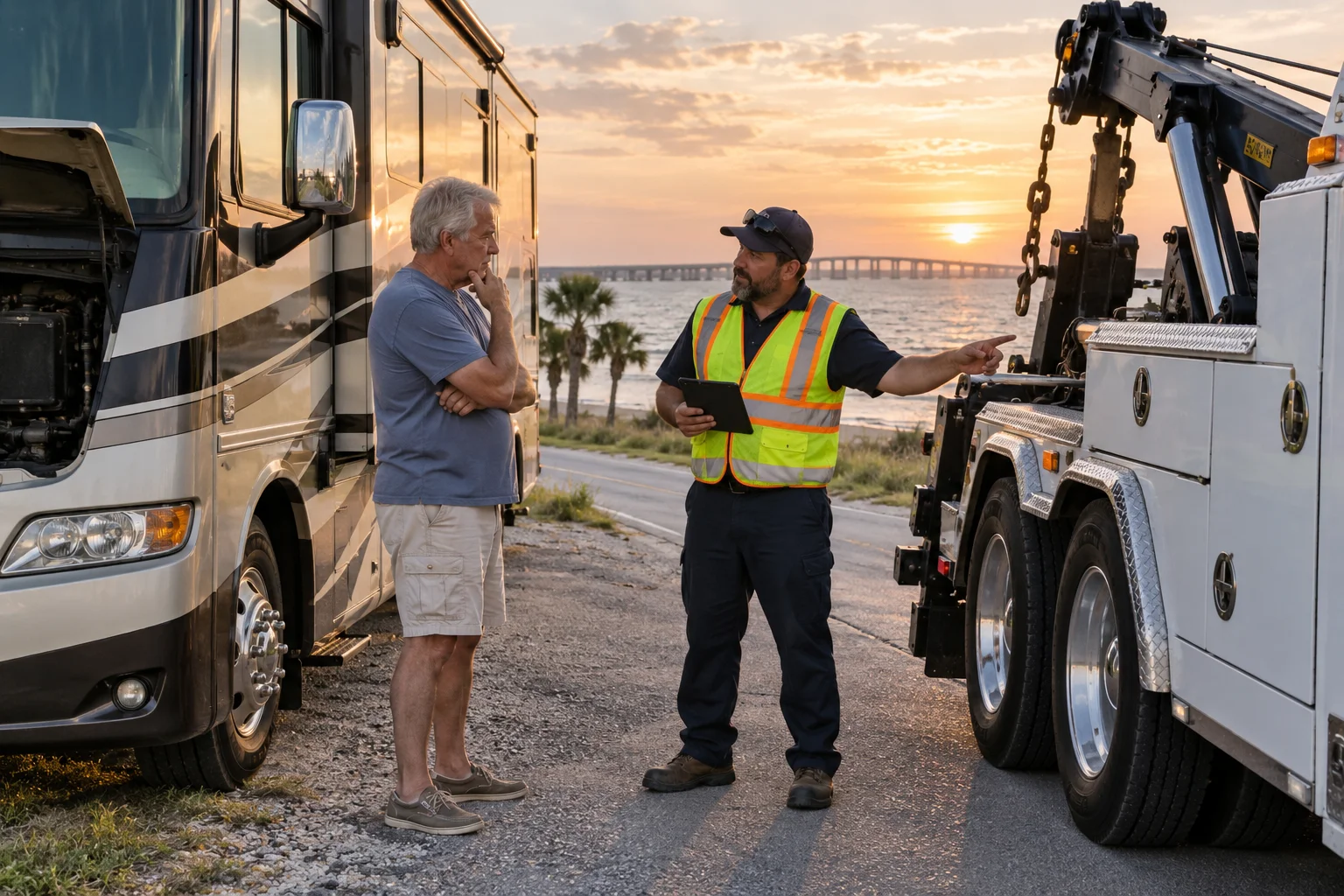
Quick Tow connects Coastal Bend callers with independent, licensed towing operators. We don’t own tow trucks or perform the work. Use this guide to give an operator the details needed to assess your job.
Identify the motorhome or trailer configuration
Begin with the broad vehicle type. Tell the operator whether you have a motorhome, travel trailer, fifth-wheel, or another trailer configuration. Don’t stop at saying “RV.” That word covers vehicles with very different frames, hitches, wheels, and access points.
For a motorhome, share the manufacturer, model, and model year. Explain whether it can roll, steer, and shift as expected. Mention anything attached behind it, including a car or trailer. The operator needs to consider the complete roadside situation, not just the main vehicle.
For a travel trailer, identify the tow vehicle and hitch style. Say whether the trailer remains connected. If it separated, describe where each vehicle stopped. For a fifth-wheel, tell the operator whether it’s still coupled to the pickup.
Don’t rely on a generic towing rule found online. A percentage rule can’t confirm the correct truck, connection method, or recovery plan. Use the RV manufacturer’s information and the identification labels on your vehicle. Let the operator compare those details with the equipment being dispatched.
Our RV and trailer towing service page explains how referrals work. The related Corpus Christi RV towing guide covers common breakdown decisions. This page focuses on comparing operator fit before accepting a tow.
Corpus Christi proper isn’t the whole service area. Say whether you’re in Portland, Flour Bluff, Padre Island, Robstown, Kingsville, or another Coastal Bend community. A location across the Harbor Bridge presents a different dispatch decision than one inland.
Share dimensions and manufacturer information
Give the operator verified information from the RV itself. Useful details include its overall length, height, width, manufacturer, model, and model year. Read the values from the manufacturer’s label, manual, or current documentation when possible.
Don’t estimate a dimension because the RV “looks standard.” Accessories can change its working profile. Mention roof-mounted equipment, awnings, ladders, storage boxes, bike racks, and anything attached at the rear. Tell the operator about slide-outs and whether they’re fully retracted.
Share the vehicle identification number only when the operator says it’s needed. You can usually begin the equipment discussion with the manufacturer and model. Keep registration or manufacturer documents nearby so you can confirm details without guessing.
Ask the company to explain what information it used to select the truck. A good comparison isn’t based on the biggest-sounding vehicle description. It’s based on whether the dispatched equipment matches the RV and the planned movement.
Texas requires towing companies operating tow trucks over public roadways to be licensed, subject to specific statutory exemptions. Operator licenses also vary by the towing performed. You can check an operator through the Texas Department of Licensing and Regulation license search. Select “Tow Truck Operators,” then search by name, license number, city, county, or ZIP code.
Every operator in our network is licensed and insured. Quick Tow itself is a referral service, not the towing licensee. The driver contracts with and pays the matched operator directly.
Describe the hitch, wheels, and road position
The operator needs a clear picture of what failed. Start with the hitch. Say whether it appears connected, twisted, dropped, bent, or separated. Don’t crawl under the RV to inspect it from a traffic lane.
Next, describe every wheel you can see safely. Report a flat tire, missing wheel, damaged rim, locked wheel, or an axle that appears out of position. Avoid diagnosing the mechanical cause. Describe what you see and let the operator decide what it means for towing.
Road position matters just as much. Tell the company whether the RV is:
- In a campground or storage lot
- Parked at a home
- On a paved shoulder
- Blocking a traffic lane
- Angled into sand, grass, or a ditch
- Stopped beneath a structure or near an overhead obstruction
Share the road name, travel direction, nearest exit, and a visible landmark. On Padre Island or near the JFK Causeway, distinguish the island side from the Corpus Christi side. Near Portland, say which side of the Harbor Bridge you’re on. Inland, name the nearest town and route rather than saying you’re “outside Corpus.”
Photos can help when they show the whole RV, hitch area, affected wheels, and surrounding space. Take them only from a safe position. Don’t stand in traffic or between unstable vehicles.
Our Aransas Pass RV breakdown guide offers more location-specific preparation. Clear scene details help the operator assess access without pretending one truck fits every RV.
Compare roadside help with an RV tow
Not every RV problem starts with a tow. A dead battery, lockout, fuel need, or tire problem may call for roadside help. The deciding factor is whether the issue can be handled safely where the RV sits and whether the matched operator offers that service.
Coverage is a separate question. Roadside plans and insurance policies set their own terms. Don’t assume a plan covers an RV, attached trailer, tow from home, chosen destination, or every service charge. Ask the provider directly and request the applicable coverage details.
Have these questions ready:
- Does my plan cover this exact RV or trailer?
- Does coverage apply at its present location?
- Can I choose the destination?
- Is the tow vehicle covered separately?
- Must the provider approve service before dispatch?
- Which charges remain my responsibility?
If you’re calling without a membership, say so. A towing operator can still discuss the job, but don’t assume any tow will be free. Confirm who authorizes payment and who will receive the bill before work begins.
A roadside visit can also become a tow if the problem can’t be handled at the scene. Ask how the operator will communicate that change and what new authorization is required. Don’t approve work you don’t understand.
If the RV’s size or condition falls outside ordinary equipment, ask whether heavy-duty towing is the appropriate referral. That page doesn’t determine the answer by itself. The operator still needs the vehicle details and scene conditions.
Confirm capacity, destination, and the quote
Before agreeing to service, ask the operator to confirm that its equipment fits the reported RV. Don’t request a particular truck based only on a photo or general label. Ask how the RV’s dimensions, configuration, wheel condition, and road position affected the selection.
Then confirm the destination. Give the exact business name and address if you have them. Ask the repair facility, campground, storage property, or dealer whether it can accept the RV. Confirm access details directly with that destination. Quick Tow can’t verify another property’s availability or acceptance rules.
Discuss the full route with the operator. A tow from Flour Bluff toward Corpus Christi differs from a movement between Robstown and Kingsville. Likewise, a pickup in Portland may involve the Harbor Bridge. The operator needs both endpoints before quoting the job.
Ask for the quote before work begins. The matched operator sets the price, not Quick Tow. Confirm what the quote covers and what conditions could change it. Useful questions include:
- Is the quote based on the details I provided?
- Does it include the complete destination?
- Could recovery work change the charge?
- Are the RV and attached vehicle treated separately?
- What payment methods does the operator accept?
- Who should approve changes during the job?
Don’t blend consent-tow pricing with Texas nonconsent towing caps. A tow you request yourself isn’t covered by those TDLR caps. Keep the operator’s name, license information, quoted terms, and destination together for reference.
When to call us
Call when your motorhome or trailer needs a licensed towing operator and the equipment match isn’t clear. Share the RV configuration, dimensions, wheel condition, road position, and destination.
Call us at (361) 967-8088 and we’ll connect you with a licensed operator.