A disabled car in Kingsville may need more than a generic tow request. Describe its condition first, so the operator can evaluate the vehicle and loading space before accepting the call.
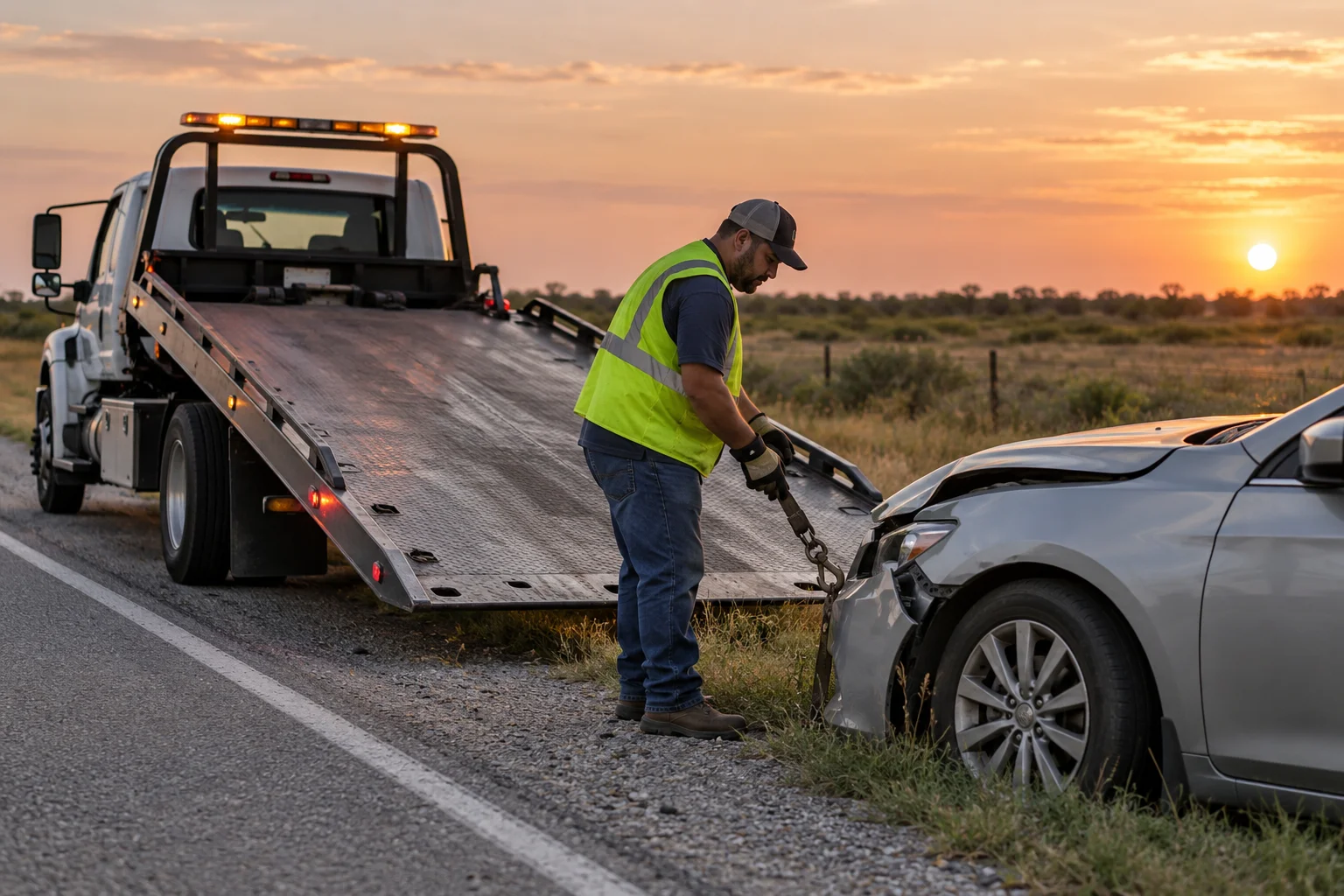
Describe why the vehicle cannot drive
Start with what happened immediately before the vehicle stopped. Tell the referral line whether the engine died, a warning appeared, or the car was parked when the problem began. Don’t diagnose a mechanical failure unless a technician already confirmed it.
Explain what the vehicle can still do. Does the engine start? Can it idle? Does it move under its own power? Can the transmission enter neutral? Those details help an independent operator assess the request before heading to Kingsville.
Mention visible damage without guessing about hidden damage. Useful details include a hanging panel, leaking fluid, a low corner, or debris around the vehicle. If the car was in a collision, say that at the beginning. An accident scene may need a different response than a standard disabled-vehicle tow. Our guide to accident recovery near Kingsville explains that distinction.
Share the year, make, model, and body style. A sedan, pickup, van, and electric vehicle don’t present the same equipment questions. Also mention modifications such as reduced ground clearance or oversized tires. Don’t assume that requesting a flatbed settles every equipment decision.
If you’re unsure whether roadside work or towing fits, describe the symptoms without choosing for the operator. A dead battery may call for roadside help. A vehicle that can’t roll or steer may need towing equipment. Our emergency towing service covers calls where a disabled vehicle needs an operator rather than routine transport.
Share wheel, steering, and drivetrain condition
Wheel condition matters because a vehicle may not roll normally. Tell the referral line whether all four tires are inflated and attached. Report any wheel that looks bent, turned sharply, pushed inward, or unable to rotate. If a brake appears locked, say what you observed rather than naming the cause.
Next, describe the steering. Can the steering wheel turn? Are the front wheels pointed straight or at an angle? Is the key present? Does the vehicle have push-button ignition? These answers can affect how the operator evaluates the loading problem.
Don’t lock or unlock the steering based on general internet advice. Instructions for flat towing don’t automatically apply to a vehicle being loaded onto a flatbed. The correct setup depends on the exact vehicle, its condition, and manufacturer guidance. Let the licensed operator choose the loading approach after inspecting it.
Share the drivetrain if you know it. State whether the vehicle is front-wheel drive, rear-wheel drive, all-wheel drive, or four-wheel drive. If you don’t know, provide the vehicle identification details requested by the operator. Don’t guess. An incorrect drivetrain description can lead to the wrong assumptions during dispatch.
Also explain whether the transmission can shift into neutral. If it can’t, don’t force the shifter or drag the vehicle yourself. Tell the operator that the vehicle remains in park or gear.
A flatbed request should center on equipment matching, not a universal loading rule. Our flatbed towing service describes the service, while the operator matched to your call decides whether the available truck and loading equipment fit your specific vehicle.
Explain the pickup location around Kingsville
A street address is useful, but a precise pin is better. Send the vehicle’s map location and describe what surrounds it. State whether it’s in a driveway, parking lot, repair shop, roadside shoulder, gated property, or unpaved area.
For car towing near US 77, don’t rely on “outside Kingsville” as the location. Share the direction of travel, the nearest visible exit or cross street, and a map pin. Tell the referral line whether the vehicle is completely off the travel lane.
If the car is at a business, give the business name and the part of the property where it’s parked. “Behind the building near the loading area” is more useful than the street address alone. Mention gates, parking controls, narrow entrances, low branches, or vehicles blocking direct access.
For a residential pickup, describe the driveway surface and slope. Say whether the disabled vehicle faces the street or the house. Mention another car parked in front of it. The operator needs the scene as it exists, not how it normally looks.
Kingsville is also a common starting point for trips toward Corpus Christi or nearby communities. Pickup and destination are separate details, so provide both. If the destination isn’t decided, say that plainly. Don’t ask an operator to begin transport without a clear delivery point and authorization to leave the vehicle there.
Quick Tow Corpus Christi is a referral service. We connect callers with independent operators serving the Coastal Bend. We don’t own tow trucks, choose a loading method, or perform the tow.
When access changes the loading plan
The requested truck still needs usable space around the vehicle. A flatbed operator must evaluate the actual approach, vehicle position, and surrounding obstacles. Don’t promise that a truck can enter a property based only on the driveway width.
Photographs can help explain the scene. Take wide photos showing the vehicle, entrance, nearby cars, overhead obstacles, and available working area. Take close photos of damaged wheels or low body panels.
Tell the referral line about:
- Locked gates or access codes
- Parking garages or covered areas
- Tight turns and narrow driveways
- Soft ground, sand, mud, or uneven pavement
- A vehicle blocked by another parked car
- A low front bumper or damaged suspension
- Missing keys or inaccessible steering
- Property rules that limit entry
If the vehicle sits inside a garage or enclosed parking area, provide the posted clearance. Don’t assume a flatbed can enter. The operator may need to discuss another way to reach the vehicle, but only that operator can select the equipment and procedure.
A roadside shoulder creates different access concerns than a repair-shop lot. Keep the vehicle location exact and describe surrounding traffic. Texas law covers stationary tow trucks using the required visual signals. Approaching drivers must change lanes when the law’s lane conditions apply, or reduce speed as specified by state law. That rule is for passing drivers. It doesn’t make a roadside loading area risk-free.
Share the limitations, then let the licensed operator inspect the scene and explain the available options.
Confirm the equipment, destination, and quote
Before accepting the match, repeat the vehicle details and ask what equipment the independent operator plans to send. Confirm that the operator understands the wheel, steering, drivetrain, clearance, and access conditions you reported. If new damage appears, update the operator before loading begins.
A common “80% towing rule” isn’t a useful way to select a flatbed for a disabled car. Towing-capacity discussions don’t replace vehicle-specific equipment matching. The operator needs the actual vehicle, condition, pickup scene, and destination.
Flatbed towing isn’t automatically priced above every other towing method. Our published flatbed rate starts at the same $125 hookup as light-duty service and covers the first five miles. Vehicle size can increase the starting price. Additional mileage is published at roughly $3 to $5 per mile after those five miles.
Those are this site’s published figures, not a guaranteed total or a statutory cap. Quick Tow doesn’t set the independent operator’s price. The operator matched to the call quotes the price before doing the work. Ask what the quoted amount includes and whether vehicle condition, access, mileage, or after-hours service changes it.
Confirm the complete destination address. State whether the vehicle is going to a home, repair shop, dealership, storage facility, or another approved location. Verify that someone can receive it and that the property allows delivery. Don’t assume a closed business will accept a vehicle.
For more context about equipment selection, read our Corpus Christi flatbed towing guide. You can also verify a tow operator through the Texas Department of Licensing and Regulation license search. Texas requires towing operators and towing companies operating over public roadways to hold the applicable licenses, subject to stated exemptions.
When to call us
Call when a disabled vehicle in Kingsville needs a licensed towing operator and the wheel, steering, drivetrain, or access condition may affect equipment matching. Call us at (361) 967-8088 and we’ll connect you with a licensed operator.