A motorcycle breakdown on Padre Island calls for more than a general location. Share what happened, where the bike sits, whether it rolls, and where it needs to go. Those details help the independent operator assess the motorcycle tow before accepting the job.
Quick Tow connects riders with independent, licensed and insured towing operators. We don’t own towing equipment, employ drivers, or perform the tow. Our motorcycle towing referral service helps match the request with an operator serving the Coastal Bend.
Describe what happened to the motorcycle
Start with the event that stopped the ride. “My motorcycle won’t start” helps, but it doesn’t describe the entire job. Tell the operator what happened immediately before the bike became disabled.
Mention whether the motorcycle lost power, overheated, developed a flat tire, or was involved in a crash. Share any warning lights you noticed. Say whether fuel, oil, coolant, or another liquid appears beneath the bike. Don’t touch or identify an unknown liquid from the roadside.
Tell the operator if the motorcycle is upright or on its side. Report visible damage around the wheels, forks, handlebars, frame, engine case, or controls. If any loose parts remain attached, describe them without trying to remove them beside traffic.
The motorcycle’s year, make, and model also matter. Include major modifications that could affect loading. Examples include lowered suspension, a long wheelbase, wide saddlebags, a sidecar, or a custom fairing. Don’t assume every motorcycle fits or loads the same way.
If another vehicle struck the bike, explain where the impact occurred. Say whether police, emergency responders, or another towing operator are already involved. The matched operator needs to understand who controls access to the motorcycle.
A rider requesting motorcycle towing in Corpus Christi may only need to identify a city street. On Padre Island, the road label, travel direction, nearby access point, and motorcycle condition carry more weight. Give the whole picture during the first conversation.
Share your location near the causeway or Park Road 22
“Somewhere on Padre Island” isn’t a usable pickup location. Send a dropped map pin from your phone when possible. Then read the displayed road name and describe what you can see from a safe position.
A caller may see JFK Causeway or Park Road 22 on a map. Verify the label on your current navigation app before repeating it. Those references should guide the conversation, but they shouldn’t replace a pin or exact address.
If you’re near the causeway, state your direction of travel. Explain whether you’ve reached the island side, remain near the mainland approach, or are stopped somewhere between those reference points. If you’re uncertain, say so plainly and let the operator compare your pin with the map.
For a motorcycle breakdown near Park Road 22, share the closest visible intersection, business entrance, public access marker, or address. Don’t guess a mile marker. Photograph a nearby sign only when you can do so without stepping into traffic.
The pickup surface matters too. Tell the operator whether the motorcycle is in a paved parking area, beside the roadway, behind a gate, or on loose sand. Mention barriers, low clearance, narrow entrances, and parking controls visible at the location. Ask before moving the bike from its current position.
A breakdown near the JFK Causeway also differs from one farther along an island road. Our JFK Causeway breakdown guide explains the location details worth gathering for that corridor.
Location labels and road access can change. Confirm the current map information before publication and again when requesting service. If the motorcycle creates an immediate emergency, contact 911 and follow official directions.
Explain whether the bike can roll and steer
An operator needs to know how the motorcycle moves before choosing equipment. Don’t answer with “probably.” Check only what you can observe without entering traffic or forcing damaged controls.
First, say whether the motorcycle remains upright. Then explain whether each wheel appears straight and attached. Tell the operator if a tire is flat, a wheel looks bent, or a fender presses against the tire.
Next, describe the steering. Can the handlebars turn normally, or do they stop in one position? Is the steering locked? Do you have the key? If the key broke, was lost, or won’t turn, include that detail.
Explain whether the motorcycle can shift into neutral. If you can’t confirm neutral safely, say it’s unknown. Don’t drag the bike or force the transmission to test it. A motorcycle that won’t roll freely may require a different loading plan.
Brake condition also matters. Tell the operator if a brake appears locked or a lever is broken. Mention any chain or belt problem you can see. Don’t place your hands near a damaged wheel, chain, belt, or hot exhaust while checking.
Give separate answers for rolling and steering. A motorcycle may steer but not roll, or roll while the steering remains locked. Those aren’t the same loading condition.
Share the approximate motorcycle type, such as cruiser, touring bike, sport bike, scooter, or trike. Avoid guessing its weight. The year, make, model, accessories, and photographs give the operator better information.
These details help the operator decide whether the available truck and securement setup fit the request. They don’t guarantee that a particular truck will be dispatched. Final equipment decisions belong to the independent operator accepting the tow.
What to photograph before loading
Take clear photographs before the motorcycle is moved, if the location allows it safely. The goal is to document the bike’s condition and give the operator a useful view of the pickup.
Begin with a wide photograph showing the entire motorcycle. Take separate views from the front, rear, and both sides. Include the wheels, handlebars, mirrors, exhaust, saddlebags, fairings, and visible accessories.
Photograph the problem area more closely. That might include a flat tire, damaged fork, broken control, loose body panel, or leaking area. Don’t touch damaged parts to improve the photograph.
Capture the ground around the motorcycle when it helps explain the scene. A photograph can show pavement, sand, a curb, a slope, or limited working space. Another image can show a gate, height restriction, narrow entrance, or parking barrier.
Photograph visible damage before loading. Keep the original files on your phone. If the motorcycle was involved in a collision, document the bike without interfering with responders or an active investigation.
Don’t photograph personal documents for routine dispatch unless the operator specifically explains why they’re needed. Avoid sending payment-card details, identification numbers, or insurance information through an unconfirmed contact.
Send only current photographs from the actual pickup site. Old pictures can hide modifications or recent damage. If lighting makes a photo unclear, say what the image was intended to show.
Your safety comes first. Don’t stand in a traffic lane, cross moving traffic, or climb onto a barrier for a better angle. If photographs aren’t safe to take, describe the scene and wait for the operator’s assessment.
Confirm the equipment, destination, and quote
Before accepting the tow, confirm which independent operator is taking the request. Texas requires towing companies operating tow trucks over public roadways to be licensed. You can check an operator through the TDLR license search using the operator’s name, license number, city, county, or ZIP code.
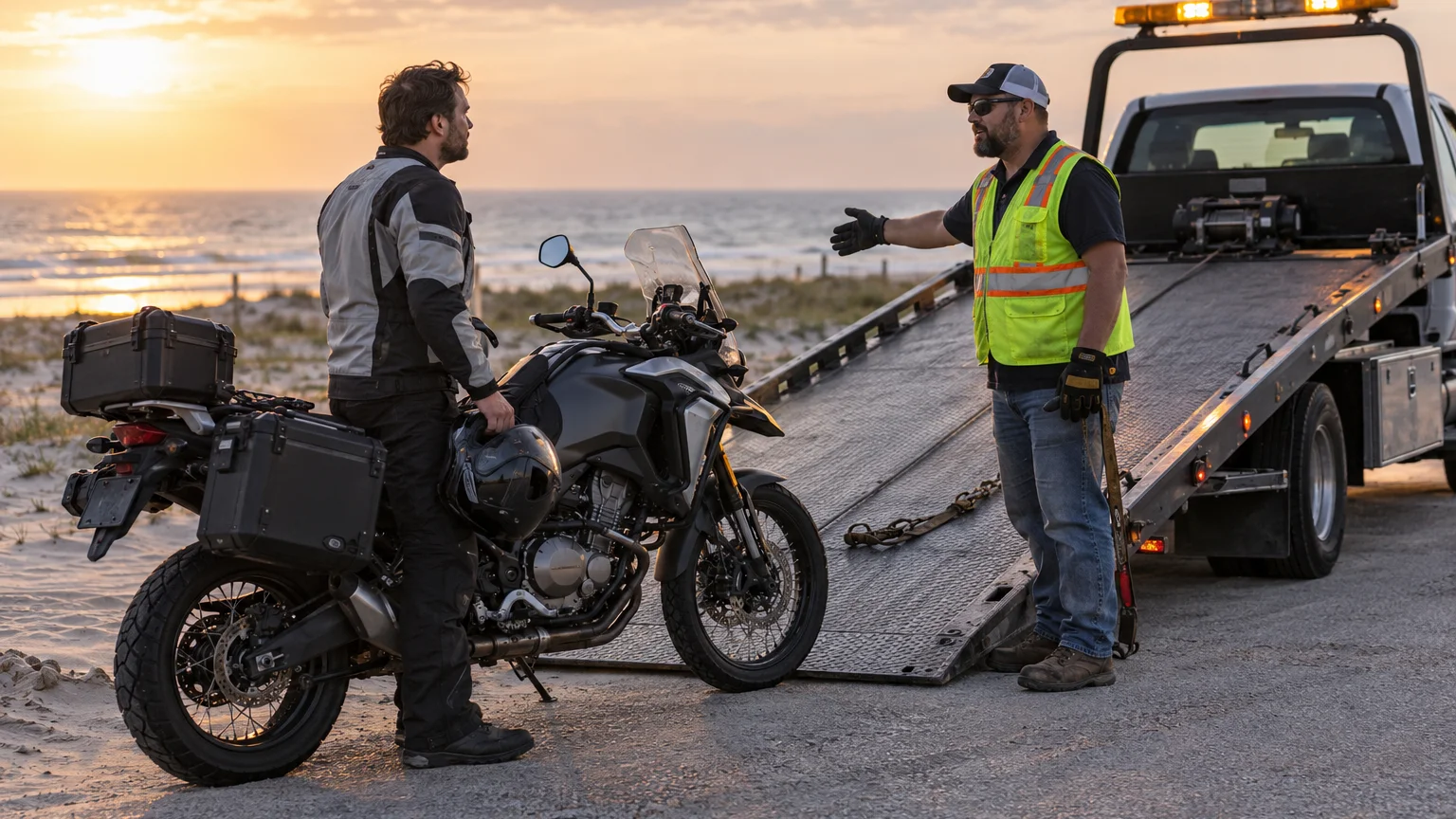
Ask what equipment the operator plans to use for your motorcycle’s reported condition. A rider can request flatbed towing, but the request doesn’t guarantee a flatbed will be available or appropriate. Describe the bike first, then let the operator explain the proposed loading method.
Confirm these details directly:
- The pickup pin, road name, and travel direction
- The motorcycle’s year, make, and model
- Whether the bike rolls, steers, brakes, and shifts into neutral
- Any crash damage, leaking fluid, or loose parts
- The truck or loading equipment the operator proposes
- The exact delivery address and receiving contact
- Whether the destination can accept the bike
- The operator’s quoted charge and payment terms
Choose the destination before loading when possible. It may be a repair shop, dealership, residence, or another property where the motorcycle may legally remain. Contact the destination yourself. Confirm its current address, access instructions, and willingness to receive the motorcycle.
Quick Tow doesn’t set the operator’s price or collect payment for the tow. The rider contracts with and pays the independent operator directly. Ask the operator to quote the job before work begins and explain what the quote covers. Distance, motorcycle condition, access, equipment, and destination can all affect the operator’s decision and charge.
Don’t blend a requested motorcycle tow with Texas nonconsent towing limits. A tow you request is a consent tow, while state caps in the approved ledger apply specifically to nonconsent tows. If any part of the quote is unclear, pause and ask the operator to explain it before loading starts.
When to call us
Call when your motorcycle can’t be ridden safely and the job needs a licensed towing operator. Share the location pin, bike condition, photographs, and destination before the match is made. Call us at (361) 967-8088 and we’ll connect you with a licensed operator.