The coupe on jack stands in a Flour Bluff garage is a different job from a running classic headed to a Saturday show. When you need to tow a non-running classic car that will not roll, the operator needs that fact before a truck is assigned. Photos, wheel condition, and how the car sits in the building matter more than a guess about the engine.
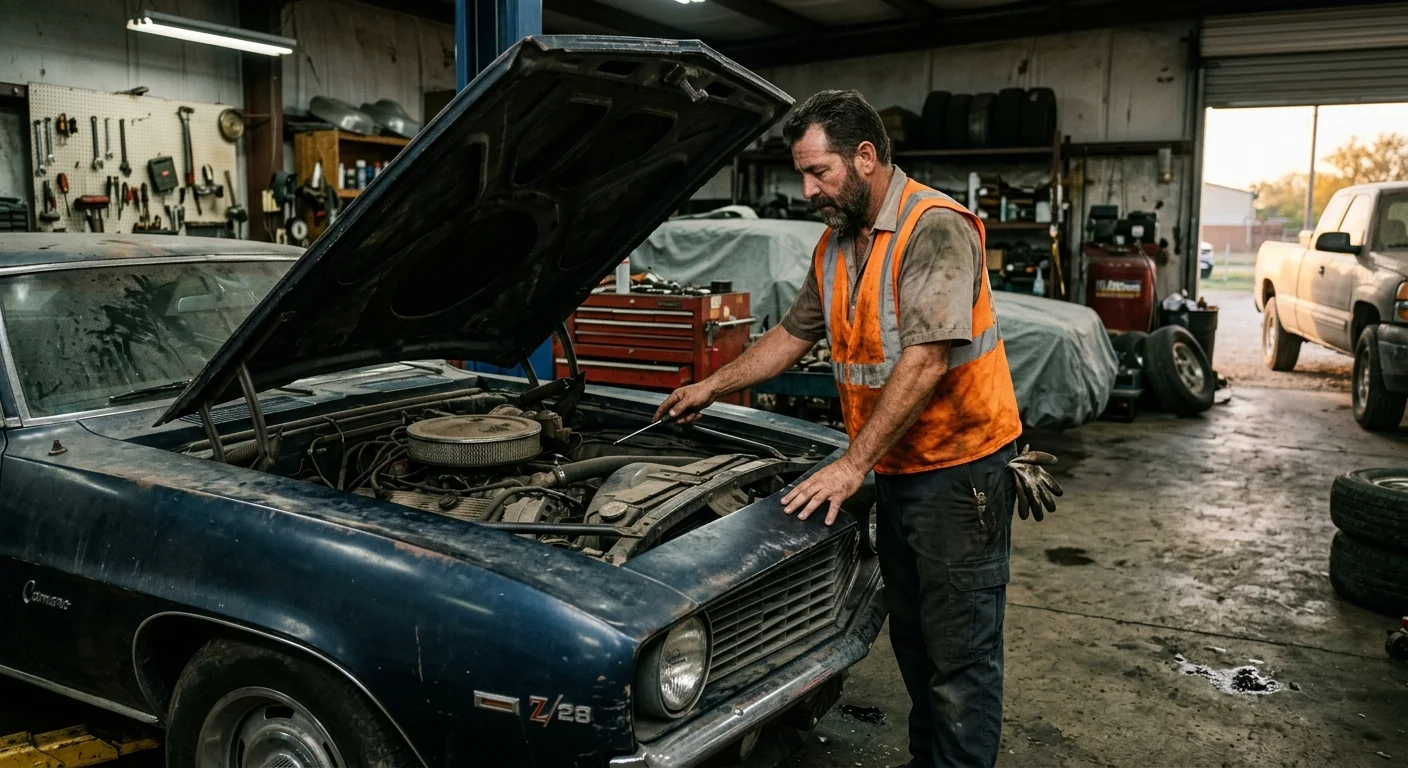
Describe why the classic car won’t roll
Yes, licensed operators can move a car that does not run. The engine is only one piece. Classic car won’t roll towing starts with what happens when someone tries to move it a few inches, not with a diagnosis you cannot prove.
Say where it has been sitting. A home garage off Waldron in Flour Bluff, a metal barn outside Robstown, a covered driveway on Padre Island, and a carport in Portland across the Harbor Bridge all change the job. Name the city and the surface. Concrete, caliche, gravel, and sand load differently. If the car has been on jack stands, wood blocks, or four flat tires, say that in the first call.
Share how long it has sat, if you know. A project that last moved last month is not the same as a car parked through several Coastal Bend summers. You do not need the exact date. “It has not rolled since before Hurricane season two years ago” is enough. If you never tried to start it, say that too. A silent key and a seized brake are different stories.
Stick to what you can see and hear. The engine may click, crank, or do nothing. There may be fluid under the oil pan, a disconnected battery, or parts stacked on the seats. Mention every modification you know: a lowered stance, side pipes, wider wheels, a fiberglass front, or a missing bumper. Do not assume the factory spec still describes this car. Our exotic and classic vehicle towing page is for this class of job. The independent operator still chooses the loading method after seeing the car.
Tell dispatch whether you have the keys. A locked steering column, a transmission stuck in park, and a car with no key are three different problems. If the title is in a drawer and the buyer is waiting in Kingsville, say who will be on site. The operator needs a person who can authorize the move, not a mechanical theory.
This page is for stored cars that cannot roll freely. A running classic that simply needs a ride across town belongs on our classic and exotic car transport guide. If the car is being scrapped rather than restored, that is a different service. Keep this call about the stored vehicle in front of you.
Share tire, wheel, brake, and steering condition
After “it will not start,” the next questions are whether it rolls, whether it steers, and whether the brakes are locked. Answer those from what you can see. Do not shove the car to test it. A dry-rotted tire or a seized drum can tear up a fender in one hard shove.
Walk around and name each corner. Is the wheel on the car. Is the tire inflated, cracked, or missing. Is the car sitting on a rim, a jack stand, or a wood block. A classic with four air-filled tires that still turn is a different load from a car with two wheels off for a brake job. Photograph each corner from wheel height. Include the spare if it is in the trunk or on the garage floor.
Check the steering without forcing it. With the key, does the column unlock. Do the front wheels change direction when you turn the wheel a little. If the lock is frozen, say so. Frozen steering changes how the operator lines the car up with the bed. The same is true if the parking brake will not release, or if you cannot shift out of park. Do not crawl under the car. Report what you can confirm from a standing position.
Brakes matter even when the engine is dead. Locked drums or seized calipers keep the tires from turning. That is the line between a car that can be winched on rolling wheels and a car that has to be slid, cribbed, or otherwise handled as an immovable load. We do not publish equipment limits for that work. Share photos and the year, make, model, and body style so the matched operator can decide. Include the manufacturer’s name as it appears on the car, plus any plate or build tag you can photograph without removing parts.
If the car sits low, add that now. A slammed Chevelle in Calallen and a stock Bel Air in a Robstown barn are not the same approach. Ground clearance, valance height, and exhaust hangers belong in the same set of photos as the tires. For stance and ramp angle, use our lowered car towing notes alongside this one. The operator still has to see this car.
Measure access around the stored vehicle
A Corpus Christi address does not describe the pickup. Moving a classic car from storage is often a building problem before it is a highway problem. Measure the path from the street to the car, then the space around the car itself.
Start at the curb. Note the street, the nearest cross street, and whether a wrecker can sit without blocking a neighbor. A quiet cul-de-sac in Annaville is not Ocean Drive. A gated lot off SPID is not a caliche drive on SH 44 west of Robstown. Share gate codes, low trees, a sharp dogleg, parked boats, and a fence that will not open fully. If the truck has to back in from a two-lane farm road, say so.
Then describe the building. Garage door height and width, how far the car sits from the opening, and whether the nose or the tail faces the door. Shelves, a freezer, a second car, a workbench, and hanging bikes all steal swing room. A barn with a dirt floor and a low header needs different photos than a two-car garage in Portland. Include the apron: steep, flat, sand, gravel, or decorative pavers. Do not guess the grade. A side photo of the doorway with a person standing in it helps more than a model year.
Give the narrowest point in plain terms. “The gate is a tight squeeze for a pickup” is useful. “There is about a car-width between the boat trailer and the pecan tree” is better. Photograph that pinch from the street and from the car. If the classic is buried behind lawn equipment, say what you can move before the operator arrives and what has to stay.
Padre Island and Flour Bluff add sand and salt air on the approach. Inland Kingsville and Robstown add longer runs and looser drives. The Northside across the Harbor Bridge adds bridge traffic and tighter residential streets. None of that is a reason to skip the call. It is a reason to describe the last fifty feet with the same care as the car.
Protect loose parts without promising damage-free transport
A stored classic often has pieces that are no longer attached the way the factory intended. Hubcaps in a box, a grille wrapped in a blanket, chrome spears on the workbench, a cardboard pattern of the headliner on the back seat. Those items can shift, scratch paint, or fall in the path of a strap. They are your job to bag, tape, or take out of the car before the operator arrives.
Remove what you can carry. Take loose trim, trophies, tools, and boxes out of the cabin and trunk. If a part must travel with the car, put it in a closed container and tell the operator it is in the trunk. Do not leave a fender leaning on the quarter panel. Do not leave a battery sitting on a floorboard where it can tip. If a bumper is tied on with wire, photograph that tie and say so. The operator should not discover a hanging valence when the car starts to move.
Photograph the car as it sits. All four corners, both sides, the roof, the interior, and any existing scratch, rust hole, or cracked lens. These photos are a record, not a warranty. No loading plan makes transport damage-free. Soft parts, old undercoating, and dry weatherstripping can mark or tear even when the operator is careful. Ask how the referred pro plans to attach straps and where they will land. Share any factory tie-down point you know from the manual. Do not invent one.
Tell the operator about fluids you can see. A drip under the engine, a wet shock, or a gas smell in a closed garage belongs on the call. Do not start topping off fluids as a transport ritual unless your mechanic already told you to. This is not a restoration checklist. It is a way to keep surprise parts and surprise leaks from becoming the loading plan.
If the car has a cover on it, say whether you will pull the cover before the truck arrives. A fitted cover that snags on a mirror helps no one mid-load. Fold it, bag it, and keep it with the loose parts.
Confirm the loading plan and destination
You can request a flatbed tow for a non-running classic. Treat that as a request, not a rule. The matched operator still has to match the bed, the winch, the ramp angle, and the wheel condition to this car and this building. A flatbed tow non-running classic car job in a tight Flour Bluff garage is not the same job as an open driveway in Calallen. Ask how the operator plans to get the car from its resting place onto the bed without dragging locked tires across a finished floor if that is the risk you are trying to avoid.
Confirm who will be there. The owner, a shop foreman, a buyer, or a relative with a signed note. The operator needs someone who can point at the car, confirm the destination, and stay clear of the loading path. If the shop in Corpus Christi closes at a set hour, say that hour. If the receiving bay in Kingsville is down a side alley, describe that alley the same way you described the pickup.
Name the destination with the same detail as the origin. A restoration stall off Leopard Street, a storage unit in Calallen, a home garage in Portland, and a buyer’s barn near Robstown each need their own access notes. Door height at the far end matters as much as door height at the start. If the car will sit on the bed for a longer Coastal Bend run, say so. Local consent tows are quoted by the operator before the work starts. Our published light-duty hookup starts at $125 for the first five miles, with extra miles often in the $3 to $5 range. After-hours work between 10 PM and 6 AM can add $25 to $50 on that published sheet. Those are this site’s published figures, not a bill. The operator you are matched with quotes the actual price for this car before loading.
Texas requires the person operating the wrecker over public roads to hold the right TDLR towing license for the work. You can look up a tow operator by name, city, or license number in TDLR’s license search. Every operator in the network is licensed and insured. The operator performs the work and chooses the gear after seeing the photos and the site.
If the wheels will not turn and the building is tight, say that again when you confirm the plan. A clear “it will not roll, it will not steer, and the garage is a one-car stall” keeps the wrong truck from being sent. A vague “it’s a project car” does not.
When to call us
Call when a stored classic will not roll and you need it moved to a shop, a buyer, or another building in the Coastal Bend. Have the year, make, model, photos of the wheels, and a description of the garage or barn ready. Call us at (361) 967-8088 and we’ll connect you with a licensed operator.